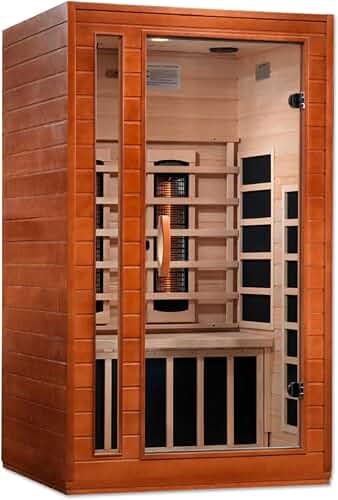
Finding the best 3 person infrared sauna for low ceiling basement installations means working within tight vertical clearances. Most standard 3-person infrared saunas measure 75 to 77 inches tall, which leaves almost no breathing room under a typical 84-inch basement ceiling and zero clearance under a 78 to 80-inch ceiling once you account for ductwork or beams. The right model needs a cabin height under 72 inches, a flat (non-peaked) roof, and front-mounted carbon heaters that do not require overhead airflow. This 2026 buyer's guide walks through the exact dimensions, panel layouts, and assembly tricks that make a three-seater fit comfortably in a sub-80-inch space.
Why basement ceiling height is the biggest constraint
Most U.S. basements were framed to building code minimums, often 7 feet (84 inches) for finished living space, and 6 feet 8 inches (80 inches) under ductwork, joists, or beams. Once you account for the assembled height of a typical 3-person infrared sauna (75-77 inches), plus the 1-2 inches of clearance you need above the roof for assembly and for the integrated chimney vent, you are already over budget. A standard 3-seater simply will not slide into place under a low joist or duct soffit, and forcing it under a beam usually means you cannot get the roof panel seated correctly.
When shopping for best 3 person infrared sauna for low ceiling basement, it pays to compare specs, capacity, and real-world runtime before committing.
The fix is not to abandon the idea of three seats. Several manufacturers now build three-person cabins around shorter wall panels (68 to 71 inches tall), with low-profile flat roofs and recessed bench heights to compensate. The trade-off is a slightly tighter interior feel, but you keep the triple capacity that makes group sessions possible, which is the whole reason someone shops for a 3-person model in the first place.
The dimensions that actually matter
Before you shop, measure three numbers in your basement and write them down:
- Lowest point of the ceiling across the entire footprint of the sauna, not just where you plan to center it. Pipes, ducts, and beams often hang 4 to 8 inches below the drywall, and many low-ceiling basements have one offending obstruction that dictates the whole install.
- Doorway and stair landing clearance. Every wall panel must travel down the stairs and around any turn at the bottom. Pre-built panels are typically 68 to 77 inches tall and 24 to 36 inches wide, and a 90-degree turn at the bottom of a basement stair is often the real limiting factor, not the ceiling itself.
- Outlet location and amperage. Most 3-person infrared saunas pull 15 to 20 amps on a dedicated 120V circuit, though some larger full-spectrum models require 240V. You want the outlet within 5 feet of the sauna so you are not running an extension cord, which voids most warranties.
For the best 3 person infrared sauna for low ceiling basement use, the target spec sheet is a cabin under 72 inches tall, a footprint around 60 x 48 inches, and panels narrow enough to navigate a standard 32-inch basement stair turn.
What to look for in a low-clearance 3-person sauna
Flat or recessed roof design
Avoid models advertised as having a peaked or tongue-and-groove vaulted roof. Those styles add 2 to 4 inches of height at the apex and are designed for above-ground installs in a spare bedroom, not for fitting under a duct. Look for a flat plywood or hemlock roof panel that sits flush with the wall tops. Some manufacturers also offer a removable chimney vent that you can leave off if your ceiling clearance is critical, though you will lose a small amount of passive ventilation in exchange.
Front-facing heater placement
Cheaper 3-person cabins use ceiling-mounted heater panels to claim a higher emitter count. In a low basement, these are a problem: they radiate heat upward toward an already-warm joist cavity, and they raise the effective interior temperature gradient in a way that makes the upper foot of the cabin uncomfortable. Prioritize models that place all carbon or ceramic emitters on the front wall, side walls, and behind the bench, with none in the ceiling.
Bench height around 17 to 18 inches
A standard sauna bench sits at 18 to 20 inches off the floor. Dropping it to 17 inches gains you headroom for taller users without changing the cabin's overall height. Several Canadian hemlock 3-seaters now ship with a slightly lower bench specifically for basement buyers, while the cabin footprint stays the same.
Panel-based construction
If your basement has narrow doorways or a tight stair turn, prebuilt one-piece sauna kits are a non-starter. You want a kit that ships flat with individual wall, floor, roof, and bench panels that snap together with buckle clasps or tongue-and-groove edges. Two adults can usually assemble a panel-style 3-person cabin in 60 to 90 minutes once the parts are in the room.
EMF, wood quality, and the things people overlook
Basements are damp by nature, which makes wood selection more important than it would be in a dry upstairs spare room. Canadian hemlock is the most common choice and resists warping well, but if your basement runs over 60% relative humidity in summer you may want to look at western red cedar or basswood for added rot resistance. Running a dehumidifier within 10 feet of the sauna helps any wood last longer, regardless of species.
Low-EMF construction matters more in a basement, too, because you are typically closer to electrical service panels and home wiring runs. A reading of under 3 milligauss at the bench is the rule of thumb for carbon panel heaters. If you are sensitive to EMF or just want the lowest-radiation option, our low-EMF sauna roundup covers the certified models worth considering for tight indoor spaces.
Electrical and venting considerations
Three-person infrared saunas typically draw between 1,800 and 2,400 watts, which fits on a standard 20-amp dedicated 120V circuit. If your basement panel has room for a new breaker, this is the right time to add one. Running the sauna off a shared circuit that also powers a laundry room or freezer will trip breakers on cold-start cycles, which is annoying and shortens the heater controller's lifespan.
Venting is the part most basement installers underestimate. An infrared sauna does not produce wet steam the way a traditional Finnish sauna does, but it does push warm, slightly humid air out of the cabin during each session. A finished basement with no exterior windows can accumulate that moisture over months, leading to mildew on adjacent drywall. Plan for a small bath-style exhaust fan within 10 feet of the sauna, or position the cabin under or near an existing HVAC return vent so the moisture is pulled into your home's air handler.
For step-by-step electrical, framing, and access prep, our home infrared sauna installation guide covers the full punch list, including basement-specific gotchas like sub-slab moisture barriers.
Common basement install mistakes to avoid
Three patterns come up repeatedly in customer reviews from basement buyers:
- Measuring only the open ceiling area. They forget the joist or beam that runs over one corner of the sauna footprint, and the roof panel will not seat. Always measure the lowest point across the entire planned footprint, not just the center.
- Placing the sauna directly on bare concrete. Concrete pulls heat out of the floor panel and can wick moisture upward into the wood. Lay down a foam puzzle-mat or rubber gym tile underlay first; it costs $30 and adds an inch of insulation.
- Skipping the dedicated circuit. A 3-person sauna on a shared 15-amp basement circuit will trip breakers, dim lights, and gradually overheat the wiring. This is the most common warranty complaint and the easiest to prevent.
If you want a fuller walkthrough of pre-purchase pitfalls, our infrared sauna buying mistakes guide covers the rest, including return-policy traps unique to oversized freight items.
When a 2-person model is actually the smarter pick
If your basement ceiling is under 78 inches at any point in the planned footprint, or if your stair turn is tighter than 30 inches at the narrowest, you are almost always better off with a corner-style 2-person cabin instead of forcing a 3-person model into a space it does not fit. The 2-person form factor often comes in 71-inch and even 68-inch heights, with much shorter wall panels that navigate stairs more easily. Capacity is lower, but installation success rates are dramatically higher. Compare options in our 2-person infrared sauna roundup if you want to weigh the trade-off honestly.
How to finalize your shortlist
Once you have your basement measurements in hand, narrow the search to models that publish all three of these specs on the product page: external height, external width and depth, and individual panel dimensions for shipping. If a manufacturer hides any of those numbers, skip the listing, because that information is usually missing from low-quality imports that will not fit a basement install. Also confirm the warranty covers the heater controllers separately from the wood cabin, because controllers are the most common failure point and the cheapest part to replace if covered.
For broader buying criteria that apply to any infrared sauna purchase (not just basement installs), our infrared sauna buying guide covers heater types, warranties, and full-spectrum versus far-infrared trade-offs in detail. With the right specs in hand, the best 3 person infrared sauna for low ceiling basement use is genuinely attainable in 2026 without compromising on capacity or build quality.
Frequently Asked Questions
What is the shortest 3-person infrared sauna available in 2026?
The lowest-profile production 3-person infrared cabins currently measure about 68 to 71 inches tall, achieved by combining shorter wall panels with a flat roof and a 17-inch bench. Most manufacturers do not advertise these as basement editions, so you have to read the spec sheet carefully. Anything taller than 72 inches will be a problem under a standard 80-inch finished basement ceiling once you account for assembly clearance.
Can I install a 3-person infrared sauna under a 7-foot basement ceiling?
Yes, if the cabin is 75 inches or shorter at its tallest point (including any chimney vent) and there are no beams or ducts hanging below the joists in the footprint area. A true 7-foot (84-inch) flat ceiling gives you 9 inches of clearance for a 75-inch cabin, which is enough for assembly and for the warm air column above the roof. Anything under 80 inches of ceiling clearance is risky for most stock 3-person models.
Do I need a 240-volt outlet for a 3-person infrared sauna in my basement?
Most 3-person far-infrared saunas run on a standard 120V/20A dedicated circuit and pull 1,800 to 2,400 watts. Only full-spectrum 3-person cabins that include near-infrared heaters typically require 240V. Check the spec sheet for total wattage; anything over 2,400 watts usually needs the 240V plug, and basement panels often have an easy spot for a new 240V double-pole breaker.
Will basement humidity damage an infrared sauna cabin?
It can, over years, if your basement runs above 60% relative humidity continuously. Canadian hemlock and red cedar both tolerate damp basements well, but the heater controllers and the wiring junctions inside the wall panels do not. Run a dehumidifier when the sauna is not in use, keep the door cracked open between sessions to let interior moisture escape, and inspect the seams annually for any sign of warping or mildew.
How do you vent an infrared sauna in a finished basement?
You do not need ducted venting the way a traditional Finnish sauna requires, because infrared does not generate wet steam. What you do need is enough passive airflow in the basement to move the warm, slightly humid post-session air away from the cabin. A small bath-style exhaust fan within 10 feet of the sauna, or positioning the cabin near an existing HVAC return register, handles this for most homes.
Can a 3-person infrared sauna fit down a standard basement staircase?
Almost always yes, if you choose a panel-style kit instead of a prebuilt unit. Individual wall and roof panels for 3-person cabins typically measure 24 to 36 inches wide and 68 to 77 inches tall, which clears a standard 36-inch basement door and a 32-inch stair turn. Prebuilt one-piece 3-person saunas, by contrast, almost never fit and are best reserved for ground-floor or garage installs.
How much does it cost to install a 3-person infrared sauna in a basement?
The cabin itself runs $2,000 to $5,000 in 2026 for a quality 3-person hemlock or cedar model. Add $200 to $500 for an electrician to install a dedicated 20A circuit if one is not already in place, $30 to $80 for a foam underlay to protect against concrete cold, and optionally $150 to $300 for a small bath-style exhaust fan. Total realistic budget for a basement install lands between $2,400 and $6,000, not counting the cost of any drywall or ceiling work needed to clear hanging obstructions.
Key Takeaways
- Choosing the right best 3 person infrared sauna for low ceiling basement means matching the key features to your specific needs and budget
- Read real customer reviews and check the return policy before you commit
- Also covers: short height infrared sauna basement
- Also covers: 3 person sauna under 7 foot ceiling
- Also covers: basement infrared sauna low headroom
- Compare value across models — the priciest option is not always the best fit