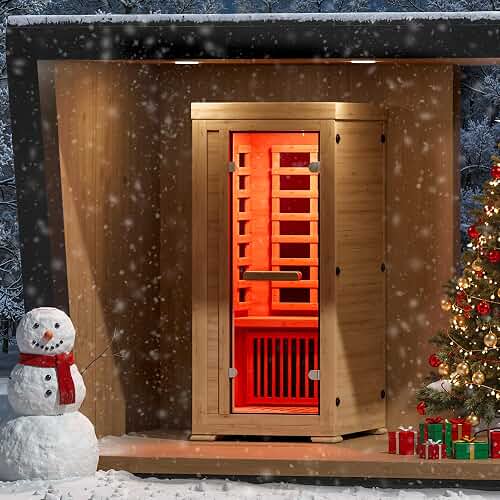
Squeezing a sauna into a compact ensuite is easier than most homeowners assume, and the best corner infrared sauna for small bathroom installs takes advantage of dead diagonal space that a rectangular cabin can never use. A triangular footprint tucks into the angle behind the door, beside the vanity, or in the unused nook between the toilet and tub, freeing up traffic lanes and floor real estate. This guide walks through footprint math, EMF safety, ventilation, electrical load, moisture control, and 2026 model considerations so your tiny master bath gains a daily wellness ritual without sacrificing the room's livability.
Why corner cabins win in a tight master bath
A standard one-person infrared cabin is roughly 36" x 36" square and demands a clear wall plus 18" of front clearance for the swinging glass door. In a 5' x 8' master bath, that geometry simply does not fit once you account for the toilet, vanity, and shower threshold. A corner unit, by contrast, uses a pentagonal or quarter-circle footprint where two walls of the cabin sit flush against existing drywall and the door swings outward into the diagonal of the room rather than into a narrow aisle.
The best best corner infrared sauna for small bathroom for your situation depends on how you plan to use it and where.
The result is a roughly 25-30% reduction in usable floor consumption versus a square cabin of the same interior bench length. You also gain a softer visual profile: the angled front face reads as furniture rather than a refrigerator, which matters enormously when the sauna sits two feet from your toothbrush.
Measuring your bathroom before you shop
Before you compare any models, take five measurements with a metal tape and write them on a notecard taped to the bathroom door.
- Corner wall lengths. Measure each of the two walls from the inside corner outward to the first obstruction (trim, outlet, towel bar). Most corner saunas need 36"-48" along each wall.
- Ceiling height. Corner units typically stand 71"-75" tall. Older homes with 7' ceilings and crown molding can run out of headroom fast.
- Door swing arc. Trace the cabin door's opening radius in chalk on the floor. If it intersects the vanity, toilet, or shower glass, you need a smaller unit or a reverse-hinge model.
- Delivery path. The largest single panel of a flat-pack corner sauna is usually 38"-44" wide. Measure the narrowest doorway and hallway turn between the front door and the bathroom.
- Outlet location. Note the distance from the corner to the nearest 15-amp or 20-amp circuit. Most one-person infrared cabins draw 1500-1800 watts and plug into a standard 120V outlet, but the cord rarely exceeds 8 feet.
If any of those measurements falls below the manufacturer's minimum, you either need a different corner, a different model, or a small remodel before the sauna arrives.
Non-negotiable specs for small-bathroom installs
When you are choosing the best corner infrared sauna for small bathroom layouts, four spec lines matter more than marketing copy:
- External footprint under 45" on each wall. Anything wider eats your vanity clearance.
- Tempered glass front, not full-wood enclosure. Glass makes a tiny room feel less claustrophobic and reflects bathroom lighting instead of absorbing it.
- Reversible door hinge or center-pivot door. Bathroom corners are rarely symmetric; you want to specify left- or right-hand swing at checkout.
- Plug-and-play 120V wiring. Hardwired 240V cabins require an electrician and a dedicated breaker, which usually breaks the budget on a small ensuite project.
Bench depth is the spec most buyers overlook. A 16" bench is fine for sitting upright but cramped if you want to bring your knees up. A 20" bench feels noticeably more lounge-like and is worth chasing if your corner can accommodate it.
EMF, ELF, and material safety in a confined room
Electromagnetic field exposure matters more in a bathroom installation than in a basement or garage because you are sitting closer to the heater elements and breathing air that has had less time to off-gas before each session. Look for cabins that publish independent EMF and ELF test results showing readings below 3 mG at the bench, ideally under 1 mG for the chest and head zones.
Wood species also matters in a humid bathroom. Canadian hemlock is the most common construction material and resists warping well. Western red cedar smells wonderful but is softer and more prone to staining from drips off the shower curtain. Basswood is hypoallergenic and the safest bet if anyone in the household has cedar sensitivity. Avoid composite or pressed-wood interiors; they release more VOCs when heated. Our low-EMF roundup walks through the testing standards in detail.
Electrical, ventilation, and moisture considerations
A 1500-watt infrared cabin pulls about 12.5 amps. If your bathroom shares a 20-amp circuit with the vanity outlet, a hair dryer running at the same time will trip the breaker. The cleanest install puts the sauna on its own 20-amp circuit, which a licensed electrician can usually pull from the panel for $250-$600 depending on wall access.
Ventilation is the second concern. Infrared cabins do not generate steam the way traditional Finnish saunas do, but they do raise ambient room temperature by 4-8 degrees during a 40-minute session. Run your bathroom exhaust fan on a timer for the full session plus 20 minutes after to keep the rest of the bathroom from becoming a sweatbox.
Moisture is more of an issue than people expect. Towels get damp, bare feet drip, and the cabin floor needs to be wiped after every use. A small bath mat under the door and a dehumidifier in the room during summer months will protect both the sauna's wood and the bathroom's grout. Our guide on home installation covers permitting, GFCI requirements, and subfloor protection.
Budget brackets and what they buy you in 2026
Corner infrared cabins for one or two people land in three rough price tiers in 2026.
$1,200-$1,800: Entry-level flat-pack units, usually hemlock, with carbon panel heaters and basic chromotherapy. Expect 6-8 carbon panels, an LED control panel, Bluetooth speakers, and a one-year heater warranty. Build quality is acceptable but seams may need to be silicone-sealed during assembly.
$1,900-$2,800: Mid-tier units add an upgrade in heater density (8-10 panels), tempered glass on two sides instead of one, oxygen ionizers, and three-to-five-year warranties. This tier is where most master-bath buyers land because the build quality justifies daily use without the price climbing into custom territory. The sub-$2000 roundup highlights several corner units in this band.
$2,900-$4,500: Premium corner cabins offer full-spectrum heaters (near, mid, and far infrared), magazine racks, foot heaters, and lifetime heater warranties. Wood is usually clear-grade basswood or premium hemlock with no knots. For a tiny master bath used daily by two adults, this tier delivers a noticeably more refined sit.
Installation tips specific to bathroom retrofits
Most corner saunas assemble in 60-90 minutes with two people, a Phillips screwdriver, and a rubber mallet. The bathroom-specific wrinkles worth planning for:
- Protect the floor during assembly. Lay down moving blankets so you don't scratch tile or vinyl when you flip panels.
- Test the door swing before final screws. Many corner units allow you to mount the door on either side; commit only after you have walked through the swing in real space.
- Caulk the floor seam. A bead of clear, mildew-resistant silicone where the cabin floor meets the bathroom floor stops shower splash from wicking under the cabin.
- Leave 2" of breathing room behind the cabin. Even though the back panels look like they want to sit flush, the heaters and wiring run cooler with a small gap.
- Pre-position the power cord. Cords usually exit the lower back panel; make sure your outlet is on the correct side before you finalize the corner.
For broader context on how a corner unit fits into the wider market, our main buying guide compares cabin styles, heater technologies, and warranty fine print.
Common mistakes that ruin a small-bathroom install
The two most expensive mistakes we see repeatedly: ordering a sauna whose external footprint matches the corner but whose door arc collides with the toilet, and assuming a standard outlet can carry the load without checking what else is on the circuit. The third, less obvious mistake is choosing a unit with the control panel mounted high on the inside front wall - in a short cabin, your forehead sits two inches from the controls, and the LCD light is bright enough to be annoying mid-session. Look for cabins with side-mounted or exterior-mounted controls.
Some buyers also forget to check whether the model they want ships in a single oversize box or multiple smaller cartons. A single 250-pound carton cannot navigate most narrow hallways, while a five-carton unit will assemble in tighter quarters without drama.
What about portable or low-clearance alternatives?
If your ceiling is below 71" or your corner walls measure under 36", a fixed cabin will not work. Two alternatives keep the daily infrared habit possible: a soft-sided portable cabin that folds into a closet, or an infrared blanket used on the bathroom or bedroom floor. Neither replicates the cabin experience perfectly, but both deliver the core thermal effect at one-third the footprint and price. Soft cabins typically need 30" x 30" of floor when set up and zero permanent footprint when stored.
Frequently Asked Questions
What is the smallest corner infrared sauna that fits a 5x8 bathroom?
One-person corner units with 36" wall lengths and a 71" height will fit a 5x8 bathroom as long as the toilet and vanity occupy the opposite long wall. Look for models advertised as "one-person corner" rather than "low-profile two-person," since the latter category typically demands 48"-50" along each wall.
Can I install a corner infrared sauna over bathroom tile?
Yes, and tile is actually one of the better substrates because it resists moisture and supports the cabin's weight evenly. Slip a thin closed-cell foam mat or rubber pad under the cabin to prevent scratches on glazed tile and to dampen any minor unevenness in grout lines. Avoid installing directly on natural stone unless you seal the stone first; sweat drips can stain unsealed marble or travertine.
Do corner infrared saunas need a dedicated electrical circuit?
Most one-person corner units run on a standard 120V/15A outlet but pull close to the circuit's capacity. If the bathroom's existing circuit also feeds a hair dryer, heated towel rail, or vanity outlet that gets daily use, a dedicated 20A circuit is the safer install. Two-person and full-spectrum corner cabins almost always require 240V hardwired service.
How much ventilation does a bathroom sauna need?
Run the bathroom's existing exhaust fan for the entire session plus 15-20 minutes after to vent residual heat and humidity. The cabin itself has small ceiling vents that handle interior air exchange; you do not need to cut additional ventilation into the cabin or the bathroom wall.
Will steam from the shower damage the sauna?
Occasional steam exposure is fine because hemlock and cedar are kiln-dried and finished to resist humidity. However, you should not run the shower and the sauna simultaneously, and you should towel-dry the cabin exterior if visible moisture beads on it after a long shower. Keeping the bathroom exhaust fan running prevents most of this issue entirely.
Can two people use a one-person corner sauna?
Technically yes if you sit shoulder-to-shoulder, but bench depth is the limiting factor. A 16"-18" bench is uncomfortable for two adults across a 40-minute session. If a couple plans to use the sauna together regularly, step up to a low-profile two-person corner unit with 48"-50" wall lengths and a 22"-24" bench.
How long does a corner infrared sauna last in a humid bathroom?
With weekly wipe-downs, dry interior wood after each session, and good bathroom ventilation, a mid-tier corner cabin should last 10-15 years before heater elements need replacing. Carbon panels typically outlast ceramic rods, and most reputable brands sell replacement panels for $80-$150 each. Wood interiors that show light grey patina can be sanded with fine-grit paper and re-oiled to look new.
Is it safe to sauna right after a shower?
Yes, and many users prefer it because warm, clean skin reaches the deep-tissue sweating phase faster. Towel off thoroughly before entering the cabin so you do not drip onto the wood floor or heater housings, and drink 12-16 ounces of water before the session to replace what you will lose.
Key Takeaways
- Choosing the right best corner infrared sauna for small bathroom means matching the key features to your specific needs and budget
- Read real customer reviews and check the return policy before you commit
- Also covers: corner sauna fits master bath
- Also covers: compact corner infrared sauna 2 person
- Also covers: small footprint corner sauna bathroom
- Compare value across models — the priciest option is not always the best fit