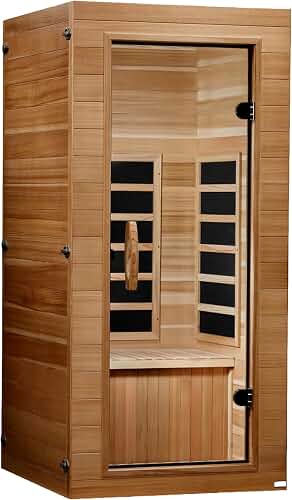
For people living with ankylosing spondylitis (AS), the first 60 to 90 minutes after waking can be the hardest part of the day — inflamed sacroiliac joints and fused vertebrae lock the spine into a painful, rigid posture that takes hours of movement to loosen. The best infrared sauna for ankylosing spondylitis morning stiffness is one that delivers deep, penetrating far- and mid-infrared heat at a temperature you can tolerate for 30 to 45 minutes, with low EMF emissions, ergonomic seating that supports a kyphotic posture, and ideally full-spectrum heaters that include near-infrared for cellular repair. This 2026 buyer's guide walks through what actually matters when you shop.
Why infrared heat helps ankylosing spondylitis specifically
AS is a chronic inflammatory arthritis that primarily attacks the axial skeleton — the spine, sacroiliac joints, and rib cage. Unlike osteoarthritis, the pain is inflammatory in nature, which is why it is paradoxically worst at rest and improves with movement and heat. That clinical fingerprint is exactly why heat therapy has been a staple of AS self-management for decades, long before infrared cabins became mainstream.
The best best infrared sauna for ankylosing spondylitis morning stiffness for your situation depends on how you plan to use it and where.
Conventional Finnish saunas heat the air to 180–195°F, which warms you only superficially through convection. Infrared saunas operate at a much gentler 110–150°F, but the infrared wavelengths penetrate roughly 1.5 inches into soft tissue, fascia, and the paraspinal musculature. For someone with AS, that means you can sit comfortably for the 30–45 minute window most rheumatologists recommend for heat therapy without spiking your core temperature into miserable territory. Lower ambient heat also matters because many people with AS also have iritis, fatigue, or cardiovascular comorbidities that make traditional saunas unpleasant or unsafe.
There is no FDA claim that infrared saunas treat AS, and you should treat this as adjunct comfort therapy that pairs with biologics, NSAIDs, and physical therapy — not a replacement. But the symptomatic relief reported by AS patients is consistent enough that the Spondylitis Association of America lists moist or radiant heat as a standard non-pharmacological option.
What to look for: the six features that actually matter
1. Full-spectrum or far-infrared with high carbon-panel coverage
Far-infrared (FIR) penetrates deepest into the joint capsules and paraspinal muscles, which is exactly what you want for AS. Carbon-panel emitters spread heat more evenly than ceramic rods, and you want panels behind your back, beside your hips, and at calf level — not just along one wall. Full-spectrum cabins add near-infrared (NIR) LEDs, which some users find helpful for skin and superficial soft-tissue work, but if budget forces a choice, prioritize wide FIR coverage over NIR add-ons. Our far vs near vs full-spectrum guide breaks down the wavelength science in detail.
2. Genuinely low EMF
AS patients often use their sauna daily or twice daily during flares, so cumulative EMF exposure matters more here than for the occasional user. Look for measured EMF below 3 milligauss at the seated position — not just at the heater surface, where any manufacturer can post a flattering number. Reputable brands publish third-party test reports for each panel. If the spec sheet only says "low EMF" without a number, assume it isn't. See our roundup of verified low-EMF cabins for current options.
3. AS-friendly ergonomics
This is the feature most generic sauna reviews miss. People with established AS often develop a forward-flexed thoracic posture, restricted neck rotation, and limited hip flexion. That changes the geometry of what a comfortable sauna looks like:
- Bench depth of 18–20 inches so you can sit fully back without forcing lumbar flexion.
- An adjustable or removable backrest — many AS users prefer a slight recline rather than upright 90° seating.
- A flat floor with no high lip to step over; stiff hips and fused SI joints make tall thresholds genuinely hazardous.
- Interior height of at least 75 inches if you have any thoracic kyphosis, so you can stand and stretch inside.
A 2-person cabin is often the sweet spot even for solo use because the extra width lets you lie supine across the bench — a position that decompresses the lumbar spine while you heat.
4. Fast warm-up time
The single biggest barrier to using a sauna for morning stiffness is the warm-up delay. If your cabin takes 25 minutes to reach 130°F, you have already lost the window when the stiffness is worst. Look for models that hit a usable 120°F in under 10 minutes, or invest in a smart-plug or app-based remote start so you can fire it up from bed.
5. The right size for your space and your spine
A 1-person sauna is cheaper and warms up faster, but if you cannot lie down inside, you lose one of the most therapeutic positions for AS. A 2-person cabin (roughly 47" wide by 40" deep) is the practical minimum for supine stretching. Avoid going larger than 3-person unless multiple household members will use it; bigger cabins take longer to warm and waste energy on empty space.
6. Hardwood that tolerates daily use
Hemlock and Canadian western red cedar are both fine. Cedar has natural aromatic oils some AS users find soothing, but a small minority with axial spondyloarthritis also have concurrent asthma or chemical sensitivity — in that case, hemlock or basswood is the safer pick.
How to actually use it for morning stiffness
The protocol that AS patients tend to converge on, after some experimentation, looks roughly like this:
- Pre-heat from bed. Use a smart plug or built-in app timer to start the sauna 15 minutes before your alarm.
- Hydrate first. 16–20 oz of water with electrolytes before you step in. Dehydration worsens AS-related fatigue.
- 30–40 minute session at 130–140°F. Start at the low end and add 5 degrees per week until you find your sweet spot.
- Gentle mobility inside the cabin. Cat-cow on the bench, seated thoracic rotations, hip flexor stretches, and chin tucks. The heat dramatically improves your end range.
- Cool-down stretch. Spend 10 minutes after exiting doing your standard AS extension routine — prone press-ups, wall angels, and seated thoracic extension over a foam roller. Tissue is most pliable in the first 15 minutes post-sauna.
Most AS users report meaningful improvement in morning stiffness within two to three weeks of daily use. For protocol depth, see how to use an infrared sauna and how often you should use one.
Realistic expectations and safety caveats
An infrared sauna will not slow the radiographic progression of AS, reverse syndesmophyte formation, or replace TNF inhibitors. What it can reasonably do is shorten your morning stiffness duration, reduce reliance on as-needed NSAIDs, and make your physical therapy and exercise routine more productive because you enter it already warm.
Cautions specific to AS and its comorbidities:
- Active uveitis or iritis flare: the photophobia makes the lit cabin uncomfortable, and dehydration can worsen anterior chamber inflammation. Skip until your ophthalmologist clears you.
- Cardiac involvement: AS can cause aortic root inflammation and conduction abnormalities. If you have any cardiac AS manifestation, get a cardiology clearance before starting daily sauna use.
- Biologic injection days: avoid the sauna for 24 hours after injection to prevent excessive local absorption and injection-site reactions.
- NSAIDs and dehydration: daily NSAIDs already stress the kidneys; the sauna adds fluid loss. Drink more than you think you need.
Budgeting and where the value lives
A reputable 2-person low-EMF cabin sits in the $2,500–$4,500 range in 2026. Going below $2,000 typically means giving up either EMF testing, heater coverage, or warranty length — three areas where AS users feel the cost most acutely. Going above $5,000 buys you chromotherapy, halotherapy salt walls, and high-end audio that are nice but irrelevant to spinal stiffness. The general buying guide walks through the full price tiers.
If a fixed cabin is not feasible — small apartment, rental, frequent moves — an infrared blanket is a legitimate fallback for AS. Blankets cannot replicate the postural decompression of lying supine in a cabin, but they deliver comparable far-infrared dose to the spine and cost a quarter as much. They are also far easier to use literally in bed during a bad flare morning.
Choosing between configurations
If you are still torn, the decision usually collapses to three scenarios. If you have stable disease and want the gold standard, a 2-person full-spectrum low-EMF cabin with carbon panels and a remote-start app gives you the best long-term value. If you are newly diagnosed and unsure how much you will actually use it, start with a quality far-infrared 1-person cabin and upgrade later — resale value on infrared saunas is reasonable. If you flare unpredictably and need bedside heat at 5 a.m., a high-quality infrared blanket beats a cabin you cannot reach.
Whichever route you choose, the best infrared sauna for ankylosing spondylitis morning stiffness is ultimately the one you will use consistently for the 30+ minutes per day it takes to make a difference. A perfectly specced cabin sitting cold in the garage helps no one.
Frequently Asked Questions
How long should an AS patient stay in an infrared sauna for morning stiffness relief?
Most AS patients land on 30 to 45 minutes per session at 130–140°F, done within the first hour of waking. Below 20 minutes the deep paraspinal tissue does not heat through; above 50 minutes you risk dehydration and post-sauna fatigue that defeats the purpose. Start at 20 minutes the first week and add five minutes weekly as tolerated.
Is far-infrared or full-spectrum better for ankylosing spondylitis?
Far-infrared does the heavy lifting for joint and paraspinal warming because it penetrates deepest. Full-spectrum adds near-infrared, which some users find helpful for surface tissue and skin, but it is not essential for AS-specific stiffness relief. If budget is tight, prioritize a high-coverage far-infrared cabin from a low-EMF brand over a cheaper full-spectrum unit with thin heater coverage.
Can I use an infrared sauna while taking biologics like Humira or Cosentyx?
Generally yes, but avoid the sauna for 24 hours after a subcutaneous injection to prevent excessive local absorption and skin reactions at the injection site. There is no known interaction between TNF or IL-17 inhibitors and infrared heat itself. Confirm with your rheumatologist, especially if you are on combination DMARD therapy.
What temperature is best for spinal stiffness?
130–140°F (54–60°C) is the sweet spot for most AS users. Lower than 125°F and you do not get sufficient deep tissue warming; higher than 145°F and tolerance drops below the 30+ minute exposure window you need. Beginners should start at 120°F for two weeks before climbing.
Should I stretch inside the sauna or after?
Both. Inside the cabin, do gentle mobility — seated thoracic rotations, chin tucks, cat-cow on the bench. Save your full extension-based AS routine (prone press-ups, wall angels, thoracic extension over a roller) for the 10–15 minute window immediately after stepping out, when tissue is maximally pliable. This is when range-of-motion gains stick.
Will daily infrared sauna use slow AS progression?
No high-quality evidence shows infrared saunas slow the structural progression of AS or prevent syndesmophyte formation. What they reliably do is reduce symptomatic stiffness, improve sleep quality, and make exercise and PT more productive — which indirectly supports better long-term outcomes. Treat the sauna as a quality-of-life tool, not a disease-modifying therapy.
Is an infrared blanket a reasonable substitute if I cannot install a cabin?
Yes, for AS specifically, a quality infrared blanket is a legitimate alternative. You lose the postural decompression of lying supine in a cabin, but you keep the deep far-infrared dose and gain the ability to use it literally in bed during bad flare mornings. Look for low-EMF, low-VOC blankets with at least 158°F maximum temperature.
Key Takeaways
- Choosing the right best infrared sauna for ankylosing spondylitis morning stiffness means matching the key features to your specific needs and budget
- Read real customer reviews and check the return policy before you commit
- Also covers: ankylosing spondylitis sauna therapy home
- Also covers: AS spine mobility infrared sauna routine
- Also covers: sauna for axial spondyloarthritis pain
- Compare value across models — the priciest option is not always the best fit