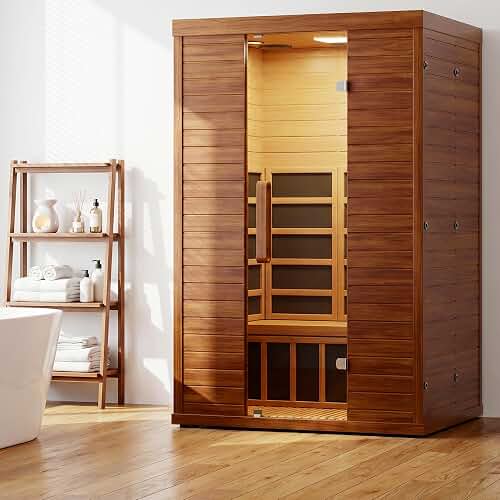
If you're searching for the best infrared sauna for ehlers danlos syndrome joint instability, the right choice prioritizes ultra-low EMF, hypoallergenic basswood construction (cedar can trigger MCAS comorbidity), a wide stable bench with full back support, and precise low-temperature control starting near 95°F (35°C). EDS bodies dump fluid fast, subluxate from minor twisting, and often run hot from autonomic dysfunction — so a sauna you can use seated, semi-reclined, or as a flat-lying blanket on flare days matters far more than maximum wattage. In 2026 the strongest setup pairs a low-EMF full-spectrum 1–2 person cabin with a sauna blanket for bedridden days.
This guide walks through what makes the best infrared sauna for ehlers danlos syndrome different from a generic wellness pick, the joint-safety features hypermobile users actually need, the temperature protocols that won't trigger POTS, and a frank look at where infrared therapy helps versus where it can quietly make hypermobility worse.
When shopping for best infrared sauna for ehlers danlos syndrome, it pays to compare specs, capacity, and real-world runtime before committing.
Why infrared (sometimes) helps EDS joint instability
Ehlers-Danlos syndrome is a heritable connective tissue disorder where defective collagen leaves ligaments, tendons, and joint capsules too stretchy to hold bones in place. The result is chronic subluxations, micro-injuries that take longer than normal to heal, and a baseline of muscle tension as your nervous system compensates for unstable joints. Many EDS patients describe their muscles as “permanently splinting.”
Infrared heat penetrates 1.5–4 cm into soft tissue, raising muscle temperature, increasing local blood flow, and easing the guarding pattern around hypermobile joints. Several small studies and a large body of patient reporting suggest infrared sessions reduce next-day pain scores, improve sleep onset in EDS-related insomnia, and lower the muscle tone that keeps unstable joints inflamed. The heat also helps comorbid Raynaud's, fibromyalgia overlap, and the cold intolerance many hEDS patients describe.
That said, heat is a double-edged sword for EDS. Collagen softens with temperature, which is why physical therapists warn hypermobile patients against hot yoga and post-sauna stretching — your tissues are temporarily more stretchy and more vulnerable to overshoot. The right sauna protocol uses heat for circulation and muscle relaxation while avoiding the post-session window when your joints have least support.
What to look for in an EDS-safe infrared sauna
Ultra-low EMF and low ELF
EDS frequently overlaps with MCAS (Mast Cell Activation Syndrome) and dysautonomia, two conditions where patients report heightened sensitivity to electromagnetic fields. Whether or not EMF symptoms are biologically validated, the practical answer is to remove the variable: choose heaters tested below 3 mG at the seated position, and below 1 mG at chest height. Look for separate ELF (extremely low frequency) testing, not just EMF, since the two are measured differently. Our round-up of the lowest-EMF infrared saunas covers verified third-party readings from the major 2026 brands.
Basswood or poplar — not cedar
Cedar smells lovely and resists rot, but its volatile aromatic oils (plicatic acid, thujone) are documented respiratory and skin sensitizers. For EDS patients with MCAS or fragrance triggers, cedar can provoke flushing, throat tightness, or full-body hives inside 90 seconds of entering a hot cabin. Basswood and Canadian hemlock are far more inert. Reclaimed Western red cedar is the worst offender; eucalyptus and poplar sit in the middle.
A stable, wide bench with back support
The single biggest ergonomic mistake EDS users make is buying a sauna with a narrow flat bench and no backrest. You then sit forward, hunched, and slowly subluxate a rib, shoulder, or SI joint over a 40-minute session. The best infrared sauna for ehlers danlos syndrome has a bench at least 18″ deep, a fully padded back panel, and ideally a contoured headrest. A second cushion behind the lumbar spine is non-negotiable for hEDS patients with chronic low-back instability.
Low step-in threshold and a sturdy door handle
High thresholds force a single-leg hop with a twist — the exact movement that dislocates EDS hips and knees. Look for a step-in under 4 inches and a magnetic or gentle-latch door so you're not yanking against your shoulder to open it. Avoid stiff barrel-sauna doors entirely.
Precise low-temperature control
Traditional Finnish-style saunas run 160–195°F. EDS patients with POTS often pre-syncope above 110°F. You want a unit that holds a stable 95–120°F (35–49°C), pre-heats with you outside the cabin, and lets you increment by 5°F. Bluetooth or smartphone control is genuinely useful here — reaching across the cabin to twist a knob is another subluxation opportunity.
Full-spectrum heaters, far-dominant
Far-infrared (5.6–1000 µm) is the gentlest, deepest-penetrating wavelength and the one most EDS users tolerate best. Mid- and near-infrared add circulation and collagen-stimulation benefits but can feel intense on fragile EDS skin. A full-spectrum unit where you can disable the near-IR panels for sensitive days is ideal. Our spectrum comparison guide breaks down which wavelengths target which symptoms.
Cabin, portable tent, or sauna blanket: which fits EDS?
One of the harder calls for hypermobile users is form factor. Each has trade-offs that map onto EDS reality:
Hardwood cabin saunas offer the best ergonomics, lowest EMF readings, the most precise temperature control, and the option to use chromotherapy and audio. They're also the heaviest investment ($2,500–$7,000), require a stable floor, and assume you can walk to them. For mild-to-moderate EDS without daily flares, a 1–2 person cabin is the strongest long-term tool.
Portable pop-up tent saunas like ceramic-element zip cabins are inexpensive ($150–$400) and let you sit in a chair with your head outside, which suits POTS patients who need their head cool. The downside: most use cheap ceramic heaters with higher EMF, a folding chair offers zero back support, and the zip enclosure traps fabric chemicals. See our portable infrared sauna picks for the few units that test low-EMF.
Infrared sauna blankets are the flare-day workhorse for EDS. You lie flat — eliminating the gravitational load on unstable joints — and the blanket wraps you in radiant heat without any seated posture demands. For bedridden days, costochondritis flares, or post-subluxation recovery, a blanket is far safer than trying to walk to a cabin. Our 2026 blanket guide covers the low-EMF, jade-stone, and Bluetooth-controlled options most worth considering.
For most hEDS patients with a moderate-severity baseline, the realistic answer is both: a small 1-person hemlock or basswood cabin for stable weeks, and a blanket for flare weeks when standing up to use the cabin isn't possible.
Real risks worth knowing before you buy
An honest EDS sauna guide has to name the risks, because most generic infrared marketing skips them:
- POTS triggering. Heat causes peripheral vasodilation, dropping return blood flow to the heart. EDS-POTS patients can pre-syncope within 10 minutes at 130°F. Pre-load with electrolyte fluid (LMNT, salt + water) 30 minutes before and have salt tablets reachable.
- Joint over-stretch window. Don't stretch, don't do PT, don't lift anything heavy for 60–90 minutes after a session. Collagen needs that long to re-stiffen. Many EDS subluxations happen post-sauna because patients feel loose and good and immediately do too much.
- MCAS flares. If you have mast cell involvement, start with 10-minute sessions at 100°F. Heat is a direct mast cell trigger. Pre-medication with H1/H2 antihistamines (per your specialist) is reasonable.
- Dehydration cascades. EDS often comes with low blood volume. Sweating compounds this. Two cups of electrolyte fluid before, one during, two after — minimum.
- Skin fragility. EDS skin is thin and bruises easily. Sit on a clean cotton towel, never bare skin directly on wood at temperature.
Always discuss new heat therapy with your EDS specialist or geneticist, especially if you have vascular EDS (vEDS), classical EDS with arterial involvement, or significant cardiac comorbidity. This guide is consumer education, not medical advice.
Our 2026 sauna selection framework for EDS
Without a single perfect “EDS sauna” on the market, the practical approach is to score candidates across the criteria above. The strongest 2026 picks are 1–2 person hemlock or basswood cabins from brands publishing third-party EMF/ELF reports, with precision low-temp control and full-spectrum heaters you can disable individually. For decision support across brands, our broader how-to-choose-an-infrared-sauna walkthrough works through wattage, voltage, warranty, and assembly factors that matter even more when you can't lift heavy panels solo.
Avoid: any sauna under $1,500 from an unknown brand (heaters are typically high-EMF), any cedar interior, any unit without published EMF data, and any model where the bench is a flat plank with no backrest. These four filters eliminate roughly 70% of the market and leave you with a manageable shortlist.
An EDS-friendly session protocol
Equipment matters, but protocol matters more. A reasonable starting protocol for hypermobile users:
- Pre-heat the cabin for 15 minutes to your target temp (start at 105°F).
- Drink 16 oz of electrolyte water 30 minutes before.
- Session length: 15 minutes for the first two weeks, increasing by 5 minutes weekly to a 35-minute ceiling.
- Sit with full back support, headrest engaged, knees at 90°, feet flat. Don't cross your legs.
- Have a phone or panic button reachable in case of pre-syncope.
- Cool down seated for 10 minutes before standing. Stand slowly with a hand on a wall.
- No stretching, no PT, no exercise for 90 minutes post-session.
- Replace fluids: 16–24 oz electrolyte water within 60 minutes.
Two to three sessions per week is the sweet spot most EDS patients describe. Daily use risks cumulative dehydration and ligament softening.
Frequently Asked Questions
Can infrared sauna make hypermobility worse?
Heat temporarily increases collagen extensibility, meaning your joints are looser for 60–90 minutes after a session. This isn't permanent damage, but it's a window where subluxations are more likely if you stretch, lift, or exercise. The fix is timing: use sauna at the end of your day, after PT and exercise rather than before, and rest after. Long-term, infrared does not worsen baseline hypermobility — the looseness window is transient.
Is infrared sauna safe with POTS and EDS together?
It can be, with precautions. Pre-load aggressively with sodium and fluid, start at the lowest temperature your sauna offers (95–105°F), keep sessions under 15 minutes initially, and have a reclining cooldown space immediately outside. Many hEDS-POTS patients tolerate infrared blankets better than cabins because lying flat prevents the orthostatic component of heat-induced pre-syncope.
What's the best sauna temperature for Ehlers-Danlos patients?
Start at 105–110°F (40–43°C) and titrate up by 5°F per week based on tolerance, with a personal ceiling typically between 125–135°F (52–57°C). Most EDS users never need or want temperatures above 140°F. Lower-temp longer sessions deliver the muscle-relaxation and circulation benefits without the POTS triggering of high-temp short sessions.
Are sauna blankets safer than cabin saunas for EDS?
For severe hypermobility, frequent subluxations, or bedridden flare days, yes — lying flat eliminates the gravitational load on unstable joints, the orthostatic challenge of standing post-session, and the ergonomic risks of a poorly designed bench. For stable hEDS patients without daily flares, a well-chosen cabin gives a fuller experience. Most EDS patients benefit from owning both.
Why does cedar bother some EDS patients?
Cedar contains plicatic acid, thujone, and other volatile aromatic compounds that are well-documented respiratory sensitizers in occupational health literature. Many EDS patients have comorbid Mast Cell Activation Syndrome, where these compounds trigger flushing, throat tightness, hives, or migraines within minutes of heat exposure. Basswood, poplar, and Canadian hemlock are far more chemically inert and the safer default.
How long should an EDS patient stay in an infrared sauna?
Begin with 10–15 minute sessions for the first two to three weeks, then add 5 minutes per week up to a ceiling of 30–40 minutes. Listen for early warning signs: dizziness, racing heart, ear ringing, or a sensation of joint “sponginess” mean exit immediately. Daily use is generally too much; two to three sessions per week is the typical sweet spot.
Does infrared sauna help EDS-related chronic pain?
Patient-reported outcomes are consistently positive for muscle-related pain — the guarding, knots, and tension that develop around unstable joints respond well to deep radiant heat. Joint capsule pain, nerve pain, and pain from active subluxation respond less predictably. Infrared is best understood as an adjunct to PT, bracing, and medical management, not a replacement for them.
Key Takeaways
- Choosing the right best infrared sauna for ehlers danlos syndrome means matching the key features to your specific needs and budget
- Read real customer reviews and check the return policy before you commit
- Also covers: EDS hypermobility infrared sauna safety
- Also covers: infrared sauna for connective tissue disorder
- Also covers: sauna for POTS comorbid with EDS
- Compare value across models — the priciest option is not always the best fit