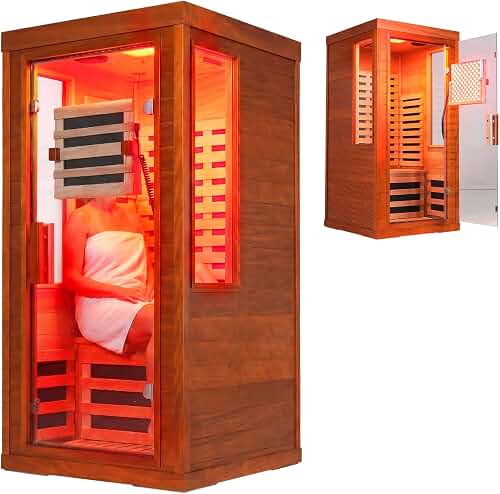
Comparison: form factors for MS heat sensitivity
| Form factor | Typical min temp | Head-out option | Exit speed if symptoms hit | Best for |
|---|---|---|---|---|
| 2-person cedar cabin | ~100°F | No (full enclosure) | Fast (door + bench) | Home users with space and a session buddy |
| 1-person cabin | ~100°F | No | Moderate (tight quarters) | Stable MS users with established protocol |
| Portable tent (head-out) | ~95°F | Yes | Very fast (unzip) | New users testing tolerance |
| Infrared blanket | ~100°F | Yes | Slower (zipper, prone position) | Experienced heat-tolerant users |
For people living with MS, the best infrared sauna for multiple sclerosis heat sensitivity is one that heats your body — not the air — at low cabin temperatures (95°F–120°F), uses far-infrared or full-spectrum emitters with verified low EMF, and includes precise temperature control plus an easy-reach emergency stop. Uhthoff’s phenomenon means even a 0.5°C rise in core temperature can temporarily worsen MS symptoms, so the right cabin lets you control dose by minutes rather than enduring the 150°F+ environment of a traditional Finnish sauna. This 2026 guide walks through MS-specific safety criteria, the features that actually matter, and how to build a low-and-slow protocol you can clear with your neurologist before your first session.
Why heat sensitivity changes the infrared sauna conversation
Roughly 60–80% of people with multiple sclerosis experience Uhthoff’s phenomenon: a transient flare of fatigue, blurred vision, weakness, cognitive fog, or numbness when core body temperature rises. The symptoms typically resolve once you cool down, but they can be frightening and disruptive. For decades this made any sauna feel off-limits. Infrared technology changes the math because the cabin itself stays much cooler than a traditional sauna while infrared wavelengths penetrate skin to raise peripheral temperature. That separation between ambient air temperature and therapeutic effect is the entire reason the best infrared sauna for multiple sclerosis heat sensitivity conversation exists at all.
The best best infrared sauna for multiple sclerosis heat sensitivity for your situation depends on how you plan to use it and where.
Crucially, no sauna is “MS-safe” out of the box. The device is only as safe as the protocol around it. Your neurologist should sign off, you should never sauna alone in the first few months, and you should have a written plan for what you’ll do if symptoms appear. With those guardrails, many people with relapsing-remitting or stable progressive MS find infrared sessions tolerable when conventional heat is not.
The non-negotiable features for an MS-friendly infrared sauna
Low minimum temperature and tight thermostat control
Most cabinets advertise a maximum of 140–150°F. What matters more for MS users is the minimum. Look for units that can hold a stable 95°F–110°F — warm enough to deliver therapeutic infrared but cool enough that ambient heat alone won’t push your core temperature. A thermostat with 1°F resolution beats one with five-degree increments.
Verified low EMF and low ELF
People with neurological conditions often want to minimize unnecessary electromagnetic exposure. Reputable brands publish third-party EMF readings at the seat position, ideally under 3 mG. See our roundup of low-EMF infrared saunas for tested options and what the numbers actually mean.
Far-infrared or full-spectrum — not near-infrared dominant
Far-infrared (FIR) wavelengths produce a gentler, deeper warming effect than near-infrared (NIR) heat lamps, which can feel intense and localized. Full-spectrum cabins let you blend wavelengths and dial down NIR until you know how your body responds. If you’re new to the wavelength debate, the far vs near vs full spectrum guide breaks down the differences in plain language.
An interior that doesn’t require physical effort
MS-related balance issues, spasticity, or weakness make the cabin layout a real safety question. Prioritize wide doors, a low step-in threshold, a sturdy bench you can sit on without lowering yourself far, and grab-friendly door handles. Interior reading lights and a clear glass door help if visual symptoms appear mid-session.
Emergency stop and external monitoring
At minimum, the controller should be reachable from the seated position. Better cabins include an external readout so a partner outside can monitor session time and temperature. Bluetooth apps that pause the heaters from a phone are a meaningful safety upgrade for solo users.
Cooling support — built-in or improvised
The post-session cool-down is as important as the session itself. A cabin with a chromotherapy-free corner where you can place a small fan, or a model with vents you can open mid-session, helps you abort a session quickly if you feel symptoms creeping in.
Sizing and form factor: cabin, blanket, or portable?
For heat-sensitive users, form factor matters as much as wattage.
Hardwired cabins offer the most temperature precision and the easiest exit. A two-person cabin is worth considering even for solo users because it gives you room to lie down with feet elevated and lets a partner sit with you during early sessions.
Infrared blankets are appealing for cost and storage, but they wrap heat directly against your core and can be harder to exit if you experience sudden weakness. They’re generally not the first choice for new MS users, though some people tolerate them well after building heat experience. Compare options in our infrared blankets roundup.
Portable tent-style saunas with head-out designs let your face and brain stay in cool room air while the body warms — an underrated advantage for heat-sensitive users. The Relax Sauna portable is one example used by some MS communities for exactly this reason.
Building a low-and-slow MS protocol
The protocol is the product. Even the best cabin used aggressively can trigger a pseudo-flare. A conservative starting framework looks like this:
- Week 1–2: 10 minutes at 100°F, twice per week, head-out if possible, with a person nearby.
- Week 3–4: 15 minutes at 105°F, three times per week, only if previous sessions caused zero symptoms in the following 24 hours.
- Week 5+: Hold at 20–25 minutes maximum and 110–115°F unless your neurologist clears longer/hotter sessions.
Pre-cool with a cold shower or 16–20 oz of ice water 15 minutes before. Drape a cool wet cloth over the back of the neck during the session. Plan a 20–30 minute post-session cool-down with electrolyte hydration. If any MS symptom — old or new — appears during or after a session, stop and reset to a lower dose. See our broader how to use infrared sauna walkthrough for general session structure, then layer the MS-specific cautions on top.
Red flags: avoid these cabins if you have MS heat sensitivity
- No published EMF testing. A spec sheet that omits EMF/ELF figures means you can’t make an informed choice.
- Fixed-output ceramic heaters with no thermostat. Some bargain cabins have a single “on” setting that drifts past 130°F. Read our list of infrared sauna buying mistakes before you commit.
- Heavy doors that swing inward. If you experience sudden weakness, an outward-swinging door you can lean against is far safer.
- Aggressive NIR-only models marketed for “recovery.” These prioritize intensity over the gentle, dose-controlled warmth MS users need.
What about commercial sauna studios?
Trying infrared at a wellness studio before buying is sensible — but ask three questions first: What is the cabin’s minimum temperature setting? Can you bring a companion? Can sessions be cut short without losing your booking fee? Many studios run cabins at a fixed 130°F+ for throughput, which defeats the entire reason an MS user is there. If a studio can’t accommodate a 100°F, 10-minute first visit, find a different studio or commit to a home unit you control. Our cost and budget guide covers the long-term math of studio visits versus ownership.
Talking to your neurologist before session one
Bring specific numbers, not a general “Can I use a sauna?” question. Show your neurologist the cabin spec sheet (wavelength, max temp, EMF data), your written protocol (starting temperature, duration, frequency), your cooling plan, and your stop criteria. Ask whether your current disease activity, medications (especially fingolimod, which can affect heart rate response), and recent MRIs change the calculus. Some neurologists will recommend a baseline cooling vest for the first month of sessions. Document each session in a symptom journal — date, temperature, duration, hydration, and any symptoms within 24 hours — so you can adjust based on data, not guesswork.
Frequently Asked Questions
Is an infrared sauna safe for someone with multiple sclerosis?
For many people with stable MS, infrared sauna use at low temperatures (95–115°F) and short durations (10–20 minutes) is tolerated without triggering Uhthoff’s phenomenon. “Safe” depends on your specific disease activity, medications, and protocol — you must get individualized clearance from your neurologist before starting, and you should never sauna alone in your first few months.
What temperature should I set my infrared sauna at if I have heat-sensitive MS?
Start at the lowest setting your cabin allows — ideally 95–100°F — for the first two weeks. Increase by no more than 5°F per week, and never exceed 115°F without explicit neurologist approval. The goal is gentle peripheral warming, not the sweat-soaked experience marketed in standard sauna content.
How long can someone with MS stay in an infrared sauna?
Begin with 10-minute sessions and cap initial protocols at 15–20 minutes. Many MS users plateau at 20–25 minutes indefinitely rather than chasing longer sessions, because dose-response benefits flatten while heat risk rises. If you feel any new symptom, stop immediately — symptom-free sessions matter more than long ones.
Will infrared sauna heat trigger an MS flare?
A true relapse (new lesion-driven symptoms lasting 24+ hours) is not typically caused by external heat. What heat can cause is a pseudo-exacerbation: temporary symptoms that resolve on cooling. Conservative dosing, hydration, and a cool head-and-neck setup dramatically reduce that risk, but they don’t eliminate it.
Are infrared sauna blankets a good choice for MS users?
Generally no for beginners. Blankets wrap heat against the torso and head area, are harder to exit quickly, and lack precise thermostat control. A head-out portable tent or a low-temp cabin gives you better dose control and faster escape. Experienced heat-tolerant MS users sometimes use blankets at the lowest settings, but it’s rarely the right first purchase.
Should I wear a cooling vest in the infrared sauna?
Some neurologists recommend an evaporative or phase-change cooling vest for the first month of sessions, particularly for users who’ve had strong Uhthoff reactions in the past. The vest blunts core temperature rise while letting peripheral tissues benefit from infrared exposure. Ask your specialist whether it’s appropriate for your case.
How often per week can MS users safely do infrared sauna sessions?
Twice weekly is a reasonable starting cadence; three times weekly is a typical ceiling once tolerance is established. More frequent sessions don’t demonstrably improve outcomes for most users and increase cumulative heat exposure. Skip any session you feel unsure about — the protocol should always serve your symptom stability, never the other way around.
Bottom line
The right infrared sauna for MS heat sensitivity isn’t the hottest, biggest, or most feature-loaded cabin — it’s the one with the lowest reliable minimum temperature, verified low EMF, an easy exit, and a manufacturer that publishes real specs. Pair that hardware with a slow-build protocol, a neurologist’s sign-off, and a symptom journal, and infrared therapy becomes one of the few heat modalities that can fit into life with MS. If you’re still narrowing options, the broader infrared sauna buying guide covers wattage, wood type, and warranty considerations that apply to every shopper, MS or not.
Key Takeaways
- Choosing the right best infrared sauna for multiple sclerosis heat sensitivity means matching the key features to your specific needs and budget
- Read real customer reviews and check the return policy before you commit
- Also covers: MS safe infrared sauna low temperature
- Also covers: infrared sauna for multiple sclerosis fatigue
- Also covers: Uhthoff's phenomenon sauna safety MS
- Compare value across models — the priciest option is not always the best fit