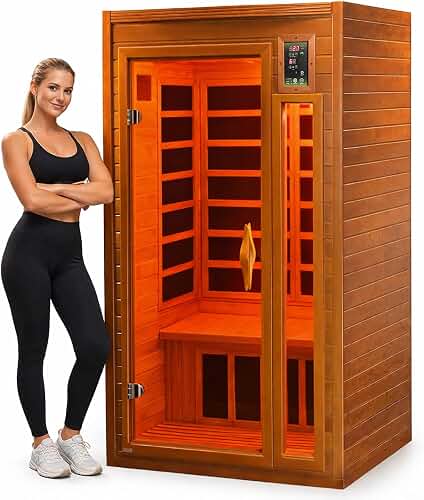
Comparison: 1-person vs 2-person cabins for 400 lb users
| Spec | Typical 1-person cabin | Typical 2-person cabin | What a 400 lb user needs |
|---|---|---|---|
| Interior width | 30-33" | 45-48" | 36" minimum |
| Interior depth | 30-32" | 38-42" | 36" minimum |
| Door opening | 19-20" | 22-24" | 22" minimum |
| Bench rating | 250-300 lb | 500-600 lb combined | 450 lb static |
| Bench depth | 14-16" | 18-20" | 18" minimum |
| Heater count | 4-5 panels | 6-8 panels | 6 panels minimum |
| Wattage | 1300-1500W | 2000-2400W | 1750W minimum |
| Typical price (2026) | $1,400-$2,000 | $1,800-$2,800 | $1,900-$2,800 range |
If you weigh 300-400 lb and want a home unit that's actually comfortable, the best infrared sauna for plus size users 400 pounds is one with a published static weight rating of at least 450 lb on the bench, a cabin interior at least 36" wide x 36" deep, a door opening of 22" or more, and heaters spaced so your shoulders, back and calves all sit inside the infrared field rather than pressed against a panel. Standard one-person cabins built around a 5'8", 180 lb user fall short on every one of those measurements, which is why most plus-size buyers end up returning their first sauna. This 2026 guide shows you exactly what specs to demand before you click buy.
Why most home infrared saunas fail plus-size users
Almost every cabin sauna under $2,500 is engineered around a single skinny adult. Manufacturers quote a "1-person" or "2-person" capacity, but those numbers describe how many people can theoretically fit, not how comfortably a 350 lb body can sit, breathe, and sweat for 40 minutes. The three failure points are always the same: the bench is rated for 300 lb or simply not rated at all, the interior depth is under 32" so your knees press against the front glass, and the door frame is 19-20" wide which forces you to turn sideways to enter. A real plus-size sauna fixes all three at once.
Finding the right best infrared sauna for plus size users 400 pounds comes down to matching the features to how you will actually use it.
The non-negotiable specs for users up to 400 lb
Before you compare brands, write these numbers down and refuse to buy anything that doesn't meet them. They are the difference between a sauna you'll use four times a week and a $2,000 closet.
- Bench static load rating: 450 lb minimum, 500 lb preferred. "Static" means continuous load, not a one-time test. If the spec sheet only lists a "user weight," email the brand for the bench rating before ordering.
- Interior width: 36" or more measured at shoulder height (not at floor level, where corner heaters narrow the usable space).
- Interior depth: 36" minimum so your knees clear the door without touching the glass. 40" is ideal if you want to stretch your legs out.
- Interior height: 75" so you can sit upright with hands raised without your scalp brushing the ceiling heater.
- Door opening width: 22" clear, measured between the hinges and the latch. A 24" door is the gold standard.
- Bench depth: 18-20". Anything less and your thighs hang off the front edge, cutting circulation within 10 minutes.
- Heater count: 6 carbon panels or 8 ceramic emitters, with at least one behind the calves and one in the floor. Plus-size users have more thermal mass to heat through, so you need more emitter area, not less.
- Power draw: 1750 watts minimum for a single-occupancy cabin sized this large, or 2400 watts if you go to a 2-person model.
Why a 2-person cabin is usually the right answer
This is the single most important tip in this guide: if you weigh 300-400 lb, buy a 2-person sauna and use it solo. The interior of a typical 2-person cabin is roughly 47" wide x 40" deep, the bench is a continuous L-shape rated for two adults (usually 600+ lb combined), and the door is almost always 24". You get all the comfort upgrades plus-size users need, and the price premium over a cramped 1-person unit is usually only $300-$500. Pair this with our best 2-person infrared saunas roundup to see current models that hit the specs above.
How to verify weight ratings before buying
Manufacturer marketing copy is unreliable. Three rules:
- Look for the rating on the technical spec PDF, not the product page bullet list. Marketing pages routinely omit weight limits because they hurt conversions.
- Ask the brand directly in writing whether the bench is rated for static or dynamic load and whether the rating covers a single point load (one person seated centrally). Save the email reply.
- Check the bench construction. Solid hemlock or Canadian red cedar planks at least 5/8" thick, supported on cleats screwed into the cabin frame every 12", will hold 450+ lb. Hollow plywood benches with hidden cardboard cores will not, regardless of what the listing claims.
For the broader framework on evaluating any cabin sauna, our complete infrared sauna buying guide walks through every spec line item with photos.
Heater layout matters more for larger bodies
A 160 lb user has roughly 19 sq ft of skin surface; a 380 lb user has closer to 28 sq ft. The same number of heater panels has to cover 47% more surface area, which is why so many plus-size users report cool spots on their back or thighs. Look specifically for:
- Wide rear-wall panels that span the full bench length, not narrow vertical strips that only hit the spine.
- Calf-level heaters under the front bench edge. These are skipped in budget builds and are exactly the heaters a plus-size user needs most because thicker legs block heat from reaching the lower body.
- Floor heating panels. A 250 watt floor heater dramatically improves whole-body sweating for heavier users and is the single biggest comfort upgrade you can specify.
- Ceiling reflectors angled inward rather than straight down, which keeps infrared off your scalp and on your shoulders.
EMF and full-spectrum considerations
Larger bodies typically run longer sessions (40-60 minutes) to reach the same core temperature rise as smaller users, which means cumulative EMF exposure matters more, not less. Stick to low-EMF carbon nano panels with documented sub-3 mG readings at the bench. Our low-EMF infrared sauna picks all publish third-party test reports. If you're choosing between far-infrared only and full-spectrum, the full-spectrum near-infrared LEDs add ~$400-$800 to the price but give you better skin penetration on thicker tissue, which is genuinely useful for plus-size users.
The pattern is obvious: only the 2-person column hits every plus-size requirement, and it does so at a price barely higher than the cramped 1-person option.
What to avoid completely
Three categories of sauna are wrong for users at this weight:
- Pop-up sauna tents. The plastic chair inside is rated for 250 lb at best, the tent zippers tear once you stretch the panels, and the heat output is too low to overcome the surface area of a larger body. Skip them.
- Sauna blankets without an XL/wide cut. Standard blankets are 71" long x 71" unzipped width. A 5'10" 350 lb user typically needs a 76" length with a 76" zipped circumference. A few brands now offer plus-size versions, but most do not.
- Corner cabins. The diagonal geometry steals 6-8" of usable depth right where you need it. Stick to rectangular cabins.
Installation and floor loading for heavier users
A 2-person cabin built to plus-size specs weighs 300-400 lb empty. Add a 380 lb occupant plus water weight in the wood and you are putting 700+ lb on roughly 12 sq ft of floor, or about 58 lb per square foot. That is well within the load capacity of any code-compliant residential floor, but you do want to position the cabin parallel to floor joists rather than perpendicular, and avoid placing it directly over a long unsupported span in a basement ceiling. Our home installation guide covers electrical, ventilation and clearance requirements in detail.
Common buying mistakes to skip
The single most expensive mistake is buying a cabin sight-unseen based on the "1-person" label and then discovering you can't close the door once seated. The second is trusting the photo: catalog images are always shot with petite models specifically to disguise the cramped interior. The third is assuming wattage equals heat; without the right heater placement, a 1800W sauna can leave a plus-size user shivering while a well-designed 1600W cabin makes them sweat. Read through our list of infrared sauna buying mistakes to avoid before you order.
Frequently Asked Questions
What is the actual weight limit on most home infrared saunas?
Most budget 1-person cabins quote 300 lb, mid-range 2-person cabins quote 500-600 lb combined (effectively 400-450 lb single-occupant), and commercial-grade cabins from premium brands rate to 700+ lb. Always check the spec PDF rather than the product page, and email the brand for written confirmation before you order if you're within 50 lb of the published limit.
Are sauna blankets a viable option for someone over 350 lb?
Only if the blanket is explicitly sold in an XL or wide cut. Standard sauna blankets have a 71" zipped circumference, which is too narrow for hips above about 60" and creates pressure points that ruin the session. A handful of brands now ship plus-size versions with 76-78" zipped widths and longer 76" lengths. Read our sauna blanket roundup to see which brands publish their wide-cut measurements.
Do I need a 240V hookup for a plus-size sauna?
No. Even a 2400W 2-person cabin runs on a dedicated 20A 120V circuit. The myth that you need 240V comes from confusion with traditional Finnish saunas, which use rock-and-steam heaters drawing 6000W+. Infrared cabins, even the large ones suitable for plus-size users, top out around 2400W and work fine on standard residential wiring.
How long should a 380 lb user stay in an infrared sauna?
Start with 15 minutes at 125°F and add 5 minutes per session until you reach 40-45 minutes at 140-150°F. Larger bodies have more thermal mass, so reaching a productive core temperature rise takes longer, but you also sweat more once you get there. Hydrate with 16-20 oz of electrolyte water before each session and the same after.
Will my knees hit the front glass in a 1-person cabin?
If you're taller than 5'10" or carry weight in your thighs, almost certainly yes in any cabin under 34" deep. This is the single most common complaint plus-size users post in reviews. The fix is to buy a 2-person cabin (38-42" deep) and use it solo. The extra $400-$600 saves you the cost of a return shipment.
Does seat width matter as much as bench rating?
Yes, often more. A bench can be rated for 450 lb and still be only 14" deep, in which case your thighs hang off the front edge and your circulation cuts out by minute 20. Demand at least 18" of bench depth. If a brand won't publish the bench depth on its spec sheet, that's usually because they know it's too shallow for larger users.
Are commercial-grade saunas worth the upgrade for home use?
For users at 350-400 lb, often yes. Commercial cabins are built to 700 lb bench ratings, use thicker hemlock or basswood paneling that doesn't warp under heavier loads, and ship with reinforced floor frames. Expect to pay $3,500-$5,000 versus $2,000-$2,800 for a consumer 2-person model, but resale value holds far better and the lifespan is typically 15+ years versus 7-10. Pair the decision with our home-use sauna roundup to compare price-to-durability across tiers.
Key Takeaways
- Choosing the right best infrared sauna for plus size users 400 pounds means matching the key features to your specific needs and budget
- Read real customer reviews and check the return policy before you commit
- Also covers: plus size infrared sauna weight capacity
- Also covers: heavy duty bench infrared sauna 400 lbs
- Also covers: wide door infrared sauna plus size
- Compare value across models — the priciest option is not always the best fit