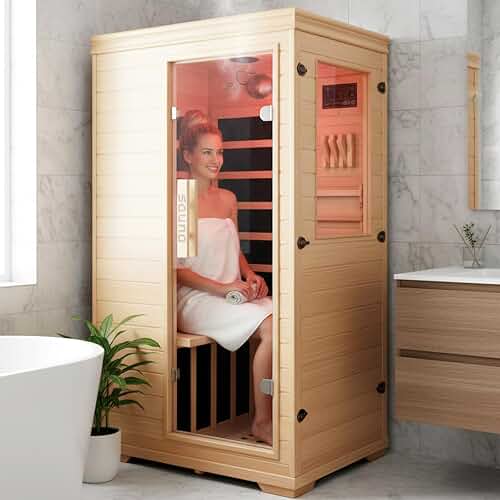
Installing a Crystal Sauna BR400 for off-grid solar cabin use is feasible in 2026, but it requires careful electrical planning. The BR400 is a four-person far-infrared sauna that draws roughly 1,950 watts continuous at 120V — a substantial but manageable load for a properly sized solar-plus-battery system. To run it reliably off-grid you typically need at least a 3,000W pure-sine inverter, a 600Ah lithium battery bank at 24V (or 300Ah at 48V), and 1.6-2.4kW of solar panels depending on latitude and how often you sauna. This guide breaks down sizing, wiring, condensation control, and realistic usage patterns for cabin installs.
Why the Crystal Sauna BR400 Suits Off-Grid Cabins
The BR400 has three characteristics that make it one of the friendlier infrared saunas for solar-powered cabins. First, it runs on a standard 120V, 15-amp circuit — there is no need for a 240V hardwire, which simplifies inverter selection and avoids the expensive split-phase setups that 240V cabinet saunas demand. Second, its hemlock cabinet is light enough (around 350 lb assembled) that you can place it on a standard cabin subfloor without major structural reinforcement. Third, far-infrared heaters reach therapeutic skin temperatures in 10-15 minutes rather than the 30-45 minutes a traditional Finnish sauna needs to heat its rocks, which dramatically cuts your kWh-per-session.
Finding the right Crystal Sauna BR400 for off-grid solar cabin comes down to matching the features to how you will actually use it.
If you are still deciding between heater types, our far vs near vs full spectrum infrared sauna guide covers why far-infrared is the practical choice for power-constrained installations — the carbon panels in the BR400 hit operating temperature with the lowest sustained wattage of any sauna category.
Real-World Power Draw of the BR400
The nameplate rating on the Crystal Sauna BR400 is 1,950W. In practice, the sauna behaves like a thermostat-controlled load: it pulls full wattage during the 10-15 minute warm-up, then cycles between roughly 600W and 1,950W to hold the cabin between 130°F and 150°F. For a typical 45-minute session (15-minute warm-up plus 30-minute soak), you should budget:
- Warm-up: 15 min × 1,950W = 0.49 kWh
- Soak (≈50% duty cycle): 30 min × 975W avg = 0.49 kWh
- Total per session: ≈1.0 kWh
That figure is the foundation of every other sizing decision. If you sauna once a day, you need to harvest, store, and deliver 1 kWh on top of the cabin's baseline draw (lights, fridge, pump, etc.). If you sauna twice a day or share the cabin with guests, double or triple that figure.
Sizing the Solar Array
Solar production for cabin systems is usually expressed in peak sun hours (PSH). A 400W panel in a location with 4 PSH (a U.S. average) produces about 1.6 kWh per day. For a single daily BR400 session plus a modest cabin baseline of 3 kWh, you are looking at 4 kWh/day total — which translates to roughly:
- 4 × 400W panels (1.6 kW array) in a sunny southwest cabin (5-6 PSH)
- 6 × 400W panels (2.4 kW array) in a mixed-climate cabin (3-4 PSH)
- 8-10 × 400W panels (3.2-4.0 kW array) in a Pacific Northwest or northern New England cabin (2-3 PSH winter average)
Always size for winter PSH, not annual average. A solar array that runs your sauna comfortably in July can leave you cold-and-dark in December. Add a 25% buffer for panel soiling, charge controller losses, and inverter conversion overhead.
Battery Bank Recommendations
Lead-acid batteries are not a good match for a sauna load because the BR400's high warm-up surge depresses lead-acid voltage and triggers low-voltage cutouts on the inverter. Lithium iron phosphate (LiFePO4) is the right choice. For a single daily session plus baseline cabin loads, the minimum practical bank is:
- 24V system: 600Ah LiFePO4 (≈15 kWh usable) — handles one session plus three days of autonomy
- 48V system: 300Ah LiFePO4 (≈15 kWh usable) — same capacity, lower current, smaller wire
The 48V configuration is preferred for any installation with cable runs over 10 feet between the battery bank and the inverter. At 48V, the BR400's 1,950W draw is about 40A on the DC side; at 24V it climbs to 80A and you need expensive 2/0 AWG cable to keep voltage drop in check.
Inverter Selection
Do not skimp on the inverter. Modified-sine and low-end pure-sine inverters can damage the BR400's PWM-controlled carbon heaters and the digital control board. You want:
- Continuous rating ≥ 3,000W (provides headroom above the 1,950W sauna draw plus any simultaneous cabin loads)
- Surge rating ≥ 6,000W for momentary inrush
- True pure-sine output with THD < 3%
- Low-frequency transformer design rather than high-frequency, for better tolerance of long-duty resistive loads
Victron MultiPlus-II 48/3000, Schneider Conext SW 4024, and the Magnum MS-PAE series are all proven choices in cabin sauna installs. Avoid stacking two smaller inverters in parallel — the BR400's cycling load can confuse load-share circuits and cause one unit to clip.
Wiring, Breakers, and Code
Run the BR400 on its own dedicated 20A circuit from the inverter sub-panel. Use 12 AWG copper minimum; if your cable run from sub-panel to sauna exceeds 50 feet, upsize to 10 AWG to keep voltage drop under 3%. Install a 20A GFCI breaker at the sub-panel rather than a GFCI outlet at the sauna — outlet-style GFCIs can nuisance-trip on the heater duty cycle.
Even off-grid, your installation should comply with the National Electrical Code. NEC 422.49 requires that fixed sauna heaters be installed per the manufacturer's instructions, and the BR400's documentation specifies a dedicated branch circuit with no other loads on it. For a full walkthrough of mounting, leveling, and clearance requirements, see our how to install a home infrared sauna guide.
Cabin-Specific Installation Considerations
An off-grid cabin presents three challenges a suburban basement install does not: condensation, ventilation, and thermal envelope.
Condensation. Infrared saunas release very little steam compared to traditional saunas, but they still off-gas about 200 mL of water per 45-minute session from the occupant. In a small, tight cabin, that moisture can condense on cold window surfaces and accelerate mold growth. Crack a window or run a small bath fan for 15 minutes after each session.
Ventilation. The BR400 itself needs at least 3 inches of clearance on all sides for its passive heat dissipation. In a cabin loft or under-eave install, verify that the ceiling is at least 7 feet high and that the roof above is insulated — a low, hot ceiling will radiate heat back into the sauna cabinet and cause the over-temperature sensor to trip.
Thermal envelope. If your cabin drops below 50°F in winter, the BR400 will need significantly longer warm-up time, which means more battery draw per session. Many cabin owners build a small insulated enclosure around the sauna — essentially a closet — and keep that closet above 55°F with a low-wattage radiant panel. The marginal energy cost is far less than the energy you save by not pre-heating a cold sauna cabinet from 40°F.
Realistic Usage Patterns Off-Grid
Solar-powered sauna sessions work best in the late morning and early afternoon — directly from the panels, without cycling energy through the battery bank. A sauna session timed for 11 a.m. through 1 p.m. in a sunny cabin draws most of its 1 kWh straight from the array, sparing you a full charge-discharge cycle and extending battery life. Evening sessions are perfectly viable but cost roughly 10-15% more total system energy because of round-trip battery efficiency.
If you are evaluating other low-EMF cabin-friendly models alongside the BR400, our roundup of the best low-EMF infrared saunas compares heater construction, EMF readings, and electrical draw across the segment.
Pros and Cons Summary
Pros for off-grid use: 120V single-circuit operation, modest 1,950W draw, short warm-up, lightweight hemlock cabinet, no plumbing required, no make-up air requirements.
Cons: The BR400 has no built-in battery-monitoring interface, so you cannot tell from the sauna's control panel how much of your bank you have consumed — you need a separate shunt and battery monitor. The cabinet is also not rated for outdoor exposure, so it must live inside the cabin envelope or in a fully weather-sealed shed.
For a broader perspective on what to look for before committing to any unit, see our general infrared sauna buying guide.
Frequently Asked Questions
Can the Crystal Sauna BR400 run on a 2,000W inverter?
Technically yes, but only barely. The BR400's continuous 1,950W draw leaves no headroom for cabin loads, and the warm-up surge can momentarily exceed 2,000W. A 3,000W continuous inverter is the practical minimum. Anything smaller risks frequent overload shutdowns and reduces inverter lifespan because the unit operates at 97%+ of rated capacity for 45 minutes at a stretch.
How many solar panels do I need to run an infrared sauna off-grid?
For one BR400 session per day plus a modest cabin baseline (3 kWh), plan on roughly 1.6 kW of panels in a sunny climate (4 × 400W) and 2.4-3.2 kW in cloudier regions. Always size for winter peak sun hours, not annual averages, and add 25% for system losses.
Will the BR400 work with a 48V LiFePO4 battery bank?
Yes, and 48V is the recommended architecture for any cabin install with cable runs longer than 10 feet. A 300Ah 48V LiFePO4 bank provides about 15 kWh of usable capacity — roughly three days of autonomy with one daily sauna session. Pair it with a 48V/3000W pure-sine inverter such as the Victron MultiPlus-II.
Does an off-grid infrared sauna need a permit?
Permitting varies by jurisdiction. In most rural counties, a freestanding plug-in infrared sauna inside a permitted cabin does not require its own permit, but the cabin's electrical system does. If the inverter sub-panel is a new installation, you will likely need an electrical permit and inspection. Always check with your local building department before energizing.
How much does it cost to add a BR400 to an existing off-grid cabin?
The BR400 itself runs about $2,400 in 2026. If your cabin already has a 3,000W+ pure-sine inverter and adequate battery capacity, that may be your entire cost. If you need to upgrade the inverter and add 400-600Ah of LiFePO4 capacity to support daily sauna use, budget another $4,500-$6,500 for the electrical upgrade plus $1,500-$2,500 for additional solar.
Can I use the BR400 in winter when solar production is low?
Yes, but you may need to ration sessions to every other day or supplement with a small inverter generator (1,000-2,000W). Many cabin owners run sauna sessions on clear winter days only and skip overcast stretches. A backup generator that recharges the battery bank for two hours after a sauna session can fully decouple the BR400 from solar production.
Does the BR400 need a dedicated ground rod off-grid?
The BR400's ground prong must connect to the cabin's grounding system. In an off-grid install, that typically means a single 8-foot copper-clad ground rod bonded to the inverter chassis and the AC sub-panel ground bus. Do not skip grounding — the carbon heater elements have a non-trivial leakage current that the GFCI breaker needs a proper ground reference to detect.
Key Takeaways
- Choosing the right Crystal Sauna BR400 for off-grid solar cabin means matching the key features to your specific needs and budget
- Read real customer reviews and check the return policy before you commit
- Also covers: off-grid infrared sauna solar power install
- Also covers: low wattage sauna for solar cabin
- Also covers: Crystal Sauna BR400 review off grid
- Compare value across models — the priciest option is not always the best fit