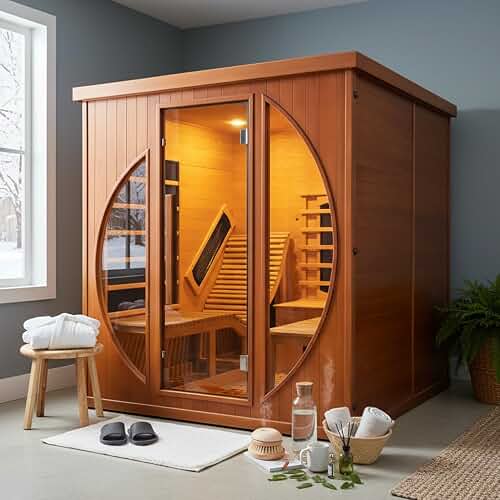
The Dynamic Andora is a one-to-two person low-EMF far-infrared cabin sauna with a corner-friendly footprint, a standard 120V plug, and Canadian hemlock construction — three qualities that make it one of the very few real wooden saunas that actually fit inside a studio rental. If you measure the typical New York, San Francisco, Toronto, or Chicago studio at 350 to 600 square feet, the Andora's roughly 35 by 35 by 74 inch envelope claims under nine usable square feet of floor and slides into a corner you were already losing to a coat rack. This guide explains exactly how the Dynamic Andora for studio apartment renters under 600 sq ft works in practice — floor space, electrical load, ventilation, noise, lease compliance, and move-out logistics — so you can decide before you order, not after the freight pallet shows up at the lobby.
Why the Andora is the realistic studio-apartment cabin sauna in 2026
Most home infrared cabins are designed for basements, garages, or dedicated wellness rooms. They assume a 240V outlet, a 4 by 6 foot footprint, and a willing homeowner who can drill into joists. The Andora was engineered against a different brief: drop into an apartment, plug into an ordinary kitchen-grade circuit, and assemble in an afternoon without a contractor. For renters that combination is rare and valuable, because it means the unit is moveable, leaves no permanent modifications, and doesn't trip the breaker shared with your microwave.
The best Dynamic Andora for studio apartment renters under 600 sq ft for your situation depends on how you plan to use it and where.
It is still a real wooden sauna with six low-EMF carbon heaters, an interior reading light, an MP3 aux input, and tempered glass — not a foldable blanket. You are choosing the smallest serious cabin on the market, not a compromise version of one. For renters who want the daily ritual of stepping into a wooden box rather than zipping themselves into a sleeping bag, that distinction matters.
Will it actually fit? The footprint math for studios under 600 sq ft
A 500 square foot studio sounds bigger than it lives. After you subtract a bed (35 sq ft), a small sofa (15 sq ft), a kitchen footprint (40 sq ft), a bathroom (35 sq ft), and circulation paths (roughly 25 percent of the remainder), you typically have 80 to 120 square feet of usable open floor. The Andora claims about 8.5 square feet of that floor. The taller question is the swing zone — the door opens outward and needs roughly 22 inches of clearance arc in front of the cabin, plus six inches of breathing room on each side and the back for the heater vents.
In practice that means you need a rectangle about 4 by 5 feet to host the unit comfortably. Common studio placements that work: the corner behind a Murphy bed, an under-utilized dining nook, the space between a closet and a wall, or in front of a non-functional fireplace. Placements that do not work: directly against radiators, under low-hanging air conditioners, or in any spot where the door arc collides with a kitchen island.
Always confirm the as-shipped dimensions on the current spec sheet before ordering, because Dynamic has updated panel thickness across model years. Our companion Dynamic Barcelona vs Andora comparison walks through the footprint differences if you are torn between the two smallest cabins in the line.
Electrical: why the 120V plug is the whole game for renters
This is the feature that makes or breaks apartment ownership. The Andora runs on a standard 120V, 15-amp three-prong household outlet. You do not need an electrician, a permit, a landlord signature, or a dedicated circuit upgrade. You do, however, need to be honest about what else lives on the same circuit.
A 15-amp circuit gives you roughly 1,800 watts of theoretical headroom and about 1,440 watts of continuous load (the 80 percent rule). The Andora draws around 1,600 watts at full heat — close enough to the continuous limit that you should not share that circuit with a space heater, microwave, hair dryer, or window AC unit running concurrently. The simple test: flip the breaker for the outlet you plan to use and see what else in the apartment goes dark. If the answer is "my entire kitchen," pick a different outlet.
Renters in pre-war buildings with two-prong outlets or aluminum wiring should be more cautious. A licensed electrician can verify the circuit for under $150 in most cities and that 30-minute visit is cheaper than a tripped breaker mid-session every night for a year.
Ventilation and humidity in a small apartment
Far-infrared saunas are dry — they do not produce the steam clouds that traditional Finnish saunas do — but a 30-minute session still releases a meaningful amount of sweat-evaporated moisture into the room. In a 500 sq ft studio with closed windows and no bathroom fan running, you can measurably raise the relative humidity for an hour after a session. Over months, that adds up to potential condensation on cold windows and, in worst cases, mildew on grout lines.
The fix is trivial: crack a window two inches during and after each session, or run the bathroom exhaust fan. If your studio has neither, a $40 small-room dehumidifier next to the cabin solves it completely. Avoid placing the Andora against an exterior wall in a climate where that wall gets cold in winter, because the temperature differential is where condensation collects.
If you want more depth on session timing and ventilation habits, our guide to using an infrared sauna covers the routine in more detail.
Floor protection and structural weight
Assembled, the Andora weighs roughly 280 to 320 pounds depending on year. That is well within the load capacity of any modern apartment floor — your refrigerator weighs more and concentrates that weight on smaller feet. Even pre-war wood-frame buildings rated for 40 pounds per square foot of live load handle the cabin without issue, because the actual pressure distributed across its base is around 35 pounds per square foot.
The bigger concern is the flooring surface itself. On hardwood, lay down a $25 rubber mat or a thin plywood platform to prevent indentation from the cabin's feet over years of use. On carpet, the same mat is essential — both for heat dispersion and to keep the unit level. On tile or vinyl plank, no protection is strictly required, though a mat still helps with leveling. Avoid placing the Andora directly on heated floors; the embedded radiant heat fights the cabin's bottom panel.
Noise: what your neighbors will (and won't) hear
The Andora has no blower and no compressor. The only mechanical noise is the very faint hum of the carbon heaters and the optional reading light, both of which are inaudible from outside the cabin. The interior speakers can be louder than is neighbor-friendly if you push them, but at conversational volume they will not transmit through a shared wall.
What your downstairs neighbor will hear is the cabin door opening and closing. The tempered-glass door is heavier than people expect; if it slams, it transmits through the floor. Closing it deliberately is a habit worth building from day one.
Assembly: one afternoon, no contractor
The Andora ships flat in two to three boxes that each fit through a standard 30-inch apartment door and into a passenger elevator. Two people can assemble it in 60 to 90 minutes using the included clasp system — the panels lock together without screws or tools beyond a Phillips head for the bench and roof trim. If you live in a walk-up, factor in that the heaviest single panel is around 55 pounds; one person can manage it, but two is much easier.
For a deeper walkthrough on placement and assembly, our home infrared sauna installation guide covers the full process step by step.
Lease compliance and move-out
Because the Andora is plug-and-play and free-standing, almost every standard residential lease classifies it as personal property rather than a fixture or modification. You do not need landlord approval the way you would for installing a 240V circuit, drilling into walls, or running a hardwired sauna. That said, it is worth a one-line heads-up to your landlord or building manager — partly out of courtesy, partly because some condo HOAs have rules about appliances over a certain wattage.
At move-out, the cabin disassembles in roughly the time it took to assemble. Keep the original boxes if your storage situation allows; if not, moving blankets and 4 by 4 foot moving boxes from a U-Haul work fine. Resale value on used Andoras has held up well — typically 50 to 65 percent of original retail in major metros — so even if you upgrade to a bigger cabin in a future house, the studio-years unit is not a sunk cost.
When the Andora is not the right pick
If your ceiling is below 76 inches you cannot stand inside the unit, which makes entry awkward — finished basements with low ceilings are a known issue. If your only available outlet is on a 10-amp circuit shared with a window AC, you will trip the breaker. If you are over 6 feet 2 inches tall, the interior bench-to-ceiling clearance gets tight for taller users; check our tall-user infrared sauna guide for alternatives. And if you genuinely cannot dedicate 9 square feet of permanent floor, a sauna blanket or portable tent is the right answer for your studio, not a cabin.
The Dynamic Andora for studio apartment renters under 600 sq ft works because it is the smallest serious cabin on a 120V plug — not because it is magic. When those conditions hold, it is the best apartment sauna decision you can make in 2026.
Frequently Asked Questions
Can the Dynamic Andora really run on a normal apartment outlet?
Yes. The Andora draws roughly 1,600 watts on a standard 120V, 15-amp three-prong outlet — the same kind of outlet your toaster uses. You do not need an electrician, a 240V dedicated line, or landlord approval for wiring. The only caveat is that the circuit should not be simultaneously running another high-wattage appliance like a microwave or space heater, because the combined load can trip the breaker.
How much floor space does the Andora actually need in a 500 sq ft studio?
The cabin itself occupies about 8.5 square feet (35 by 35 inches), but you need a usable rectangle of roughly 4 by 5 feet to account for the outward-swinging door arc and 6 inches of clearance on the sides and back for heater venting. In a typical 500 sq ft studio, that means giving up a corner you were probably under-using anyway — behind a Murphy bed, in a dining nook, or beside a closet.
Will running the sauna make my studio humid or musty?
Far-infrared saunas are dry compared to traditional steam saunas, but a 30-minute session does add moisture to a small room. Crack a window two inches during and after sessions, or run your bathroom exhaust fan, and the humidity normalizes within an hour. A small $40 dehumidifier eliminates the issue entirely in studios with no operable windows.
Is the Andora quiet enough for an apartment with shared walls?
Very. The carbon heaters are silent, there is no blower or compressor, and the only audible component is the optional interior reading light. Neighbors above, below, or beside you will not hear the sauna running. The only noise risk is the tempered-glass door closing too hard, which transmits through the floor — close it deliberately and you are invisible.
Do I need landlord permission to install a Dynamic Andora?
Under almost every standard residential lease, no — the cabin is plug-and-play, free-standing, and leaves no permanent modifications, so it qualifies as personal property rather than an installation. As a courtesy, a one-line email to the building manager is worth sending, especially in condos or co-ops with appliance rules, but you are not asking permission the way you would for a hardwired sauna.
How heavy is the Andora and will my apartment floor handle it?
Assembled, the cabin weighs around 280 to 320 pounds and distributes that weight across its full base — roughly 35 pounds per square foot of pressure, well within the live-load capacity of any modern or pre-war apartment floor. On hardwood, lay a thin rubber mat underneath to prevent long-term indentation; on carpet, the same mat helps with heat dispersion and leveling.
Is the Andora a better apartment pick than the Dynamic Barcelona?
For tight studios, usually yes — the Andora's nearly square footprint slots into corners more efficiently than the Barcelona's slightly wider rectangular base. The Barcelona has a marginally roomier interior bench, which matters more for users over six feet tall. For most renters under 6 feet 2 inches in a sub-600 sq ft studio, the Andora wins on placement flexibility. Our Dynamic Barcelona review covers the larger cabin in more detail if you have the floor space.
Key Takeaways
- Choosing the right Dynamic Andora for studio apartment renters under 600 sq ft means matching the key features to your specific needs and budget
- Read real customer reviews and check the return policy before you commit
- Also covers: Dynamic Andora small studio fit
- Also covers: Andora rental apartment landlord approval
- Also covers: Andora plug-in 120V studio
- Compare value across models — the priciest option is not always the best fit