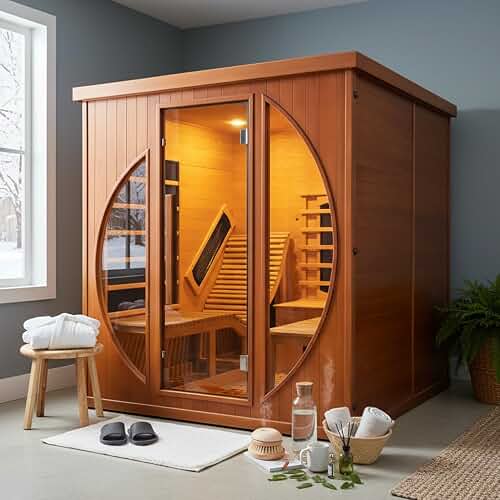
Figuring out how to vent infrared sauna finished basement no windows installations is the single biggest concern most homeowners face once their cabin arrives on a pallet. The good news: infrared saunas need far less air movement than traditional Finnish steam rooms because they produce no live steam and only modest humidity from occupant sweat. The bad news is that "less" is not "none," and a sealed basement room without operable windows still needs deliberate fresh-air exchange to handle CO2 buildup, off-gassing from new cedar or hemlock panels, and the warm, slightly humid plume that escapes every time you crack the door at the end of a session.
This guide walks through five practical venting strategies that work in a windowless finished basement, the duct routing options that avoid tearing up your drywall, and the code and electrical considerations you should plan around before the sauna is even uncrated. None of it requires a window.
The best how to vent infrared sauna finished basement no windows for your situation depends on how you plan to use it and where.
Why Venting Matters Even for an Infrared Sauna
Infrared cabins heat your body directly with light, not by superheating the air. Cabin air typically sits between 120 and 150 degrees Fahrenheit with relative humidity around 15 to 30 percent during use, climbing briefly when the door opens and warm, sweat-laden air spills into the surrounding room. In a basement with no windows, that moisture has nowhere to go except into nearby drywall, baseboards, and any fabric it touches. Over months of regular sessions, even low-humidity infrared use can produce the conditions that lead to musty smells, swollen MDF trim, and visible mold along cold concrete walls behind framing.
There are three air-quality concerns specific to a windowless basement install:
- Occupant CO2. One adult exhaling for 45 minutes in a small sealed space measurably raises CO2. Above roughly 1,500 ppm, you feel groggy and the relaxation benefit drops.
- Wood VOCs. New cedar, hemlock, and basswood off-gas terpenes and trace formaldehyde from any adhesives. Heat accelerates this for the first 30 to 60 sessions.
- Latent moisture. Sweat that lands on the bench and floor evaporates into the room over the next several hours. Without ventilation, that moisture lingers against cool surfaces.
A modest, intermittent vent solves all three at once. You are not trying to create a constant gale, just one to three full air changes per hour during and immediately after use.
How Much Air Exchange Do You Actually Need?
For a typical 2-person infrared cabin sitting in a roughly 8 by 10 foot basement room with an 8-foot ceiling, you have around 640 cubic feet of air. To achieve two air changes per hour you need roughly 21 cubic feet per minute of exhaust, ramping up to 40 to 50 CFM if you want the room to feel actively refreshed during back-to-back sessions. That is well within the range of any quality bath-style exhaust fan and dramatically less than the kitchen hood you already have upstairs.
The key is not raw fan size but where the air goes and where the replacement air comes from. A 100 CFM fan with nowhere to pull makeup air will struggle; a 40 CFM fan with a small door undercut and a return path through the basement will quietly do its job.
Five Practical Venting Strategies for Windowless Basements
1. Inline Duct Fan Routed to the Rim Joist
This is the cleanest solution when you have access to the rim joist (the framing band at the top of the foundation wall). A 4-inch or 6-inch inline duct fan sits in the joist bay above the ceiling, pulls air from a ceiling grille positioned near the sauna door, and pushes it through insulated flex duct out a small wall cap that exits just above grade. Run length stays short, the fan is silent because it lives in the ceiling cavity, and you can put it on a timer or humidistat. This is the gold-standard approach when you are figuring out how to vent infrared sauna finished basement no windows layouts and you have any exterior wall within 15 feet.
2. Bath-Style Exhaust Fan with Long-Run Ducting
If the rim joist is buried behind finished framing, a ceiling-mounted bath fan rated for long duct runs works almost as well. Look for models rated 1.5 sones or quieter at 50 to 80 CFM with a noted maximum duct run of 50+ feet. You can snake 4-inch insulated duct through the joist bays to a side-wall termination cap, often emerging behind a deck or under an overhang where it is invisible.
3. Tying Into Existing HVAC Return Air
If your furnace return runs nearby, you can add a small return grille in the sauna room ceiling and tap into the existing return trunk. This pulls warm, sweaty air back to the air handler where the AC coil dehumidifies it and the filter scrubs particulates. It only works while the HVAC blower is running, so you typically set the thermostat fan to circulate for 20 minutes after each session. Check with an HVAC tech first; some jurisdictions restrict adding new returns inside small enclosed rooms.
4. Heat Recovery Ventilator (HRV) or Energy Recovery Ventilator (ERV)
For a forever-home basement gym build, a small standalone HRV or ERV is the premium answer. These units exhaust stale air and bring in fresh outside air while exchanging heat between the two streams, so you are not dumping conditioned air outside in July or January. Panasonic, Broan, and Fantech all make compact through-wall units that vent through a single insulated penetration. Expect $700 to $1,500 installed, but you get whisper-quiet continuous ventilation for the entire basement, not just the sauna.
5. Dehumidifier Plus Air Purifier Combo (No-Duct Backup)
If you genuinely cannot run duct anywhere - say you rent, or the sauna lives in an interior closet with concrete on all sides - a 30 to 50 pint dehumidifier paired with a HEPA + carbon air purifier is the fallback. This does not replace fresh air exchange, but it pulls moisture out of the surrounding room and scrubs VOCs and odors. Pair it with cracking the sauna door open immediately after each session and leaving the basement door upstairs ajar for 30 minutes, and you can usually get by until you find a duct route.
Routing the Duct: Where Does the Air Go?
The four most common termination points for basement sauna ventilation, ranked by ease:
- Rim joist wall cap. Drill a 4-inch hole through the rim joist to a vinyl or metal hooded cap with a backdraft damper. Best option, almost always doable.
- Existing dryer vent chase. Run parallel duct in the same chase as your dryer vent (never combined, always separate). Hides the new termination near an existing one.
- Window well. If you have any egress or hopper window in the basement (even if it is not in the sauna room), the well makes a great duct exit point.
- Up through the roof. Possible but expensive - a full chase through two floors with proper fire-blocking is overkill for a 40 CFM fan.
Never terminate inside the attic, into a soffit that pulls air back into the attic, or into another interior space like a garage. Always use insulated duct between the fan and the exterior cap to prevent condensation dripping back inside the joist bay.
Electrical and Permit Considerations
Most infrared cabins already require a dedicated 20-amp 120V or 240V circuit. Add the ventilation fan on a separate 15-amp circuit if possible so the fan runs even if the sauna trips. A simple wall switch works, but pairing the fan with a humidistat or a 60-minute timer means it runs whenever you actually need it without you remembering. Most municipalities do not require a permit for a single bath-fan-style installation, but adding HVAC returns or an HRV almost always does. Read our companion guide on how to install a home infrared sauna for the full electrical, framing, and clearance walkthrough that pairs with this ventilation plan.
Step-by-Step Install Walkthrough
- Map the duct path first. Before you cut any drywall, identify the shortest straight-line route from the sauna ceiling grille to an exterior wall. Aim for under 20 feet with no more than two 90-degree bends.
- Pull the ceiling grille location. Place the intake about 12 inches in front of the sauna door, not over the cabin itself. The goal is to catch the moisture plume as it escapes.
- Cut the rim joist penetration. Use a 4-inch hole saw from inside. Slide the wall cap sleeve through, foam-seal the gap, and screw the exterior cap to the siding.
- Mount the fan. Strap the inline fan to the joists with vibration-dampening hangers. Connect insulated flex duct on both sides with foil tape and metal cinch straps.
- Wire to a timer switch. A 60-minute countdown timer in the basement room handles 95% of use cases. Add a humidistat in parallel if you want automatic operation.
- Test airflow. Hold a tissue at the grille with the fan running. It should pull firmly against the grille. Outside, the cap damper should swing open.
Common Mistakes That Cause Mold and Odor Issues
The biggest installation mistakes we see are predictable: terminating ducts in attics or soffits, undersizing the fan in a misguided attempt to stay quiet, forgetting makeup air (a door undercut of at least 3/4 inch is essential), and using thin uninsulated foil duct in cool joist bays where condensation will form. Skip these and your install will run for years without complaint. For the full punch list of cabinet, electrical, and ventilation pitfalls, review our writeup on infrared sauna buying mistakes to avoid before placing your order.
Once your venting is sorted, the long-term maintenance picture changes for the better. Wipe-downs go faster and cedar holds its color longer. Our guide to cleaning and maintaining an infrared sauna covers the weekly and monthly routines that pair naturally with a properly vented basement install.
Frequently Asked Questions
Does an infrared sauna actually need a dedicated vent like a traditional sauna?
Not in the same way - traditional steam saunas require an active intake and exhaust to keep oxygen levels safe at 180+ degrees. Infrared cabins are gentler, but in a windowless basement you still need at least one mechanical air change per hour to handle occupant CO2, VOCs, and post-session moisture. A small bath fan or inline duct fan is plenty.
Can I just run a dehumidifier instead of venting an infrared sauna in a basement with no windows?
A dehumidifier handles moisture but does nothing for CO2 or VOCs. It is a reasonable bridge solution if ducting is genuinely impossible, especially paired with an air purifier and an open basement door upstairs, but it is not equivalent to true ventilation. For a permanent install, plan on real air exchange.
How do I vent a 2-person infrared sauna in a basement closet with no exterior wall?
Tap into your HVAC return instead. Add a 6 by 10 inch return grille in the closet ceiling, run insulated duct to the nearest return trunk, and set the furnace blower to circulate for 30 minutes after each session. The AC coil and filter will handle moisture and odors. If even that is impossible, the dehumidifier-plus-purifier combo is the fallback.
Will running an exhaust fan cool down my sauna while I am using it?
No, because the fan vents the room around the sauna, not the cabin itself. The cabin is insulated and sealed; cool basement air outside the cabin does not affect interior heater performance. You only run the fan during and after the session, never during preheat.
Is it safe to use a basement infrared sauna without any ventilation at all?
For a single 30-minute session every few weeks in a large open basement, occasionally yes. For daily use, regular guests, or a sauna inside a small finished room, no - you risk elevated CO2 during sessions and chronic moisture damage afterward. Build in ventilation from day one; retrofitting later means tearing into finished drywall.
What is the cheapest way to vent an infrared sauna with no exterior wall access nearby?
The cheapest functional setup is a quiet bath fan ducted through the rim joist (under $200 in parts) wired to a timer switch. If the rim joist truly is not accessible, a 50-pint dehumidifier plus a HEPA/carbon purifier runs $400 to $600 and handles most of the problem without any ducting.
How much does it cost to install ventilation for a basement infrared sauna?
DIY with a bath fan, insulated duct, wall cap, and a timer switch runs $150 to $300 in materials. Hiring an electrician and HVAC tech to install the same system typically lands between $500 and $900. A full HRV or ERV install runs $1,200 to $2,000 but ventilates the whole basement, not just the sauna.
Once your ventilation is wired in and tested, the only thing left is to actually enjoy the cabin. If you are still tuning your routine - frequency, session length, and post-session hydration - our overview of how to use an infrared sauna pairs nicely with a properly vented basement setup.
Key Takeaways
- Choosing the right how to vent infrared sauna finished basement no windows means matching the key features to your specific needs and budget
- Read real customer reviews and check the return policy before you commit
- Also covers: basement sauna ventilation no exterior wall
- Also covers: windowless basement infrared sauna humidity
- Also covers: ducting infrared sauna finished basement
- Compare value across models — the priciest option is not always the best fit